Download
1 / 8
0 likes | 1 Views
This PDF explains how a manual changeover switch works and why it is essential for safe power switching between main supply and backup sources like generators or inverters. Learn about the working principle, key components, wiring basics, and common applications in residential, commercial, and industrial setups. The guide highlights benefits such as electrical safety, load protection, ease of operation, and cost-effectiveness, making it useful for electricians, engineers, facility managers, and anyone looking to understand reliable power transfer solutions.

E N D
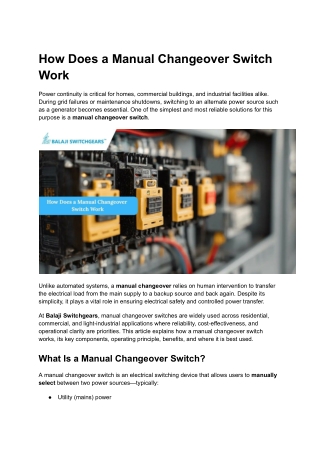
How Does a Manual Changeover Switch Work Power continuity is critical for homes, commercial buildings, and industrial facilities alike. During grid failures or maintenance shutdowns, switching to an alternate power source such as a generator becomes essential. One of the simplest and most reliable solutions for this purpose is a manual changeover switch. Unlike automated systems, a manual changeover relies on human intervention to transfer the electrical load from the main supply to a backup source and back again. Despite its simplicity, it plays a vital role in ensuring electrical safety and controlled power transfer. At Balaji Switchgears, manual changeover switches are widely used across residential, commercial, and light-industrial applications where reliability, cost-effectiveness, and operational clarity are priorities. This article explains how a manual changeover switch works, its key components, operating principle, benefits, and where it is best used. What Is a Manual Changeover Switch? A manual changeover switch is an electrical switching device that allows users to manually select between two power sources—typically: ● Utility (mains) power
● Backup power (generator or alternate supply) The switch ensures that only one power source is connected to the load at a time, preventing dangerous back-feeding and electrical faults. Unlike automatic changeover systems, a manual changeover requires a person to physically operate the switch during a power failure or restoration. Why Manual Changeover Is Still Widely Used Despite the availability of automatic systems, manual changeover switches remain popular because they: ● Are simple in design ● Require minimal maintenance ● Are cost-effective ● Provide clear visual confirmation of supply status For many applications, especially where power interruptions are infrequent or supervised, a manual solution is more than sufficient. Main Components of a Manual Changeover Switch Understanding the components helps explain how the system works. 1. Input Terminals These terminals receive power from: ● The utility supply ● The generator or alternate source Each input is electrically isolated from the other. 2. Output Terminals The output terminals connect to the load, such as: ● Distribution boards
● Essential circuits ● Machinery or equipment Only one input source feeds the output at any given time. 3. Switching Mechanism This is the core of the manual changeover switch. It mechanically transfers the connection between: ● Mains → Load ● Generator → Load The mechanism is designed so that both sources can never connect simultaneously. 4. Operating Handle or Lever The handle allows the user to manually change the position of the switch. Positions typically include: ● Mains ON ● OFF (neutral position in some designs) ● Generator ON 5. Enclosure and Safety Features The enclosure provides: ● Electrical insulation ● Protection from dust and accidental contact ● Clear labeling for safe operation How a Manual Changeover Switch Works: Step-by-Step Normal Power Condition ● Utility power is available
● The switch handle is set to the “Mains” position ● Electrical load is supplied directly from the grid During this state, the generator remains isolated from the system. During Power Failure When the utility supply fails: 1. The operator switches off sensitive loads (if required) 2. The manual changeover switch is moved to the OFF or neutral position 3. The generator is started 4. The switch is moved to the Generator ON position Now, the load receives power from the generator. Restoring Utility Power Once grid power returns: 1. The load is reduced or switched off 2. The switch is moved back to OFF 3. The generator is stopped 4. The switch is returned to the Mains ON position This controlled sequence protects equipment from voltage fluctuations and ensures safe operation. Safety Principle Behind Manual Changeover Switches The key safety function of a manual changeover switch is electrical interlocking. This prevents: ● Back-feeding power into the utility grid ● Short circuits between two power sources
● Damage to generators and electrical equipment Manual changeover switches are mechanically designed so that only one source can be connected at a time. Types of Manual Changeover Switches 1. Single-Phase Manual Changeover Used in: ● Homes ● Small shops ● Offices These switches manage lower current ratings and simpler wiring. 2. Three-Phase Manual Changeover Used in: ● Industrial units ● Commercial buildings ● Machinery and motor loads They handle higher currents and ensure phase integrity during switching. 3. On-Load vs Off-Load Changeover ● Off-load: Switching must be done when loads are disconnected ● On-load: Designed to switch under load (within rated limits) The choice depends on application and safety requirements. Advantages of Manual Changeover Switches 1. High Reliability
With no electronics or sensors involved, manual changeover switches are less prone to failure. 2. Cost-Effective Solution Compared to automatic systems, manual changeover switches have: ● Lower initial cost ● Lower installation complexity ● Minimal maintenance expenses 3. Full Operator Control The user decides when and how the power source is changed, reducing the risk of unintended switching. 4. Simple Maintenance Fewer components mean: ● Easier inspection ● Longer service life ● Reduced downtime Limitations to Consider While effective, manual changeover switches do have limitations: ● Require human presence during power failure ● Switching delay compared to automatic systems ● Not suitable for critical applications requiring uninterrupted power Understanding these limitations helps determine if manual changeover is the right choice. Common Applications of Manual Changeover Switches ● Residential backup power systems
● Small commercial establishments ● Workshops and warehouses ● Agricultural pump sets ● Light industrial panels In such environments, power interruptions are manageable and supervised, making manual changeover ideal. Selecting the Right Manual Changeover Switch When choosing a switch, consider: ● Current and voltage rating ● Single-phase or three-phase requirement ● Load type (resistive, inductive, motor loads) ● Installation environment ● Compliance with safety standards Working with an experienced supplier ensures proper selection and safe integration. Role of Balaji Switchgears Balaji Switchgears provides reliable manual changeover solutions as part of its low-voltage electrical offerings. With a strong understanding of real-world installation requirements, the company supports: ● Panel builders ● Electrical contractors ● Commercial and industrial users By focusing on safety, durability, and correct application, Balaji Switchgears helps customers implement dependable power transfer systems that perform consistently over time.
Manual Changeover vs Automatic Changeover: A Quick Comparison Aspect Manual Changeover Automatic Changeover Operation Manual Automatic Cost Lower Higher Complexity Simple Advanced Switching Time Depends on operator Instant Best For Non-critical loads Critical loads Conclusion A manual changeover switch is a simple yet essential device that ensures safe and controlled power transfer between utility and backup sources. By relying on mechanical interlocking and operator control, a manual changeover offers reliability, affordability, and ease of use for many applications. Understanding how a manual changeover switch works helps users operate it safely and choose the right solution for their needs. With the right selection and proper installation—supported by experienced providers like Balaji Switchgears—manual changeover systems continue to play a crucial role in dependable power management. Originally Published at : https://balajiswitchgears.com/how-does-a-manual-changeover-switch-work/