Unsupervised Learning Types, Algorithms and Applications
https://nixustechnologies.com/unsupervised-machine-learning/

Unsupervised Learning Types, Algorithms and Applications
E N D
Presentation Transcript
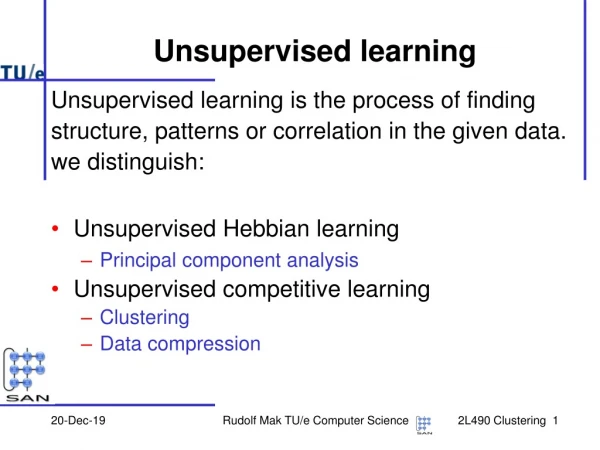
Unsupervised Learning Types, Algorithms and Applications Unsupervised Learning is a subtype of machine learning. The models here do not need labels for their data and sample outputs. Instead, they operate independently to identify patterns and trends in the data. Models train on unlabeled data and then operate on it without supervision, unlike supervised learning. Unsupervised learning is like how a human learns to think via their own experiences, bringing it closer to true AI. For example, if a baby grows up with a pet dog, it is likely to identify other dogs as similar to the pet. It does so by drawing on older experiences. Consider the following scenario: we give the unsupervised learning system an input dataset including photographs of various apples and oranges. The algorithm is never trained on the provided dataset, therefore it has no knowledge of what the dataset’s characteristics are. The unsupervised learning algorithm’s goal is to recognize visual characteristics on its own. Why is Unsupervised Machine Learning Important? Unsupervised machine learning claims to discover formerly unseen trends in data, although the majority of these trends are weak versions of what supervised machine learning is capable of. Furthermore, because we don’t realise what the results should be, we can’t tell how precise they are, making supervised machine learning more suitable to real issues.
When you don’t have data on desired results, such as selecting a target market for a completely new item that your company has never marketed before, unsupervised machine learning is the ideal option. However, supervised learning is the best strategy for improving your understanding of your current customer base. Working of Unsupervised learning models: ■ We feed the model data with no categories or outputs for training ■ Model interprets raw data to identify hidden patterns ■ Depending on data, we use suitable algorithms ■ Algorithm groups data Advantages of Unsupervised Learning: ■ Unsupervised learning is more relevant since it works with data that has no labels and has not been categorized. ■ Because we don’t always have input data that matches output data in the real world, we need unsupervised learning to solve these difficulties. ■ Because unlabeled data is simpler to get than labelled data, unsupervised learning is recommended. Disadvantages of Unsupervised Learning: ■ Unsupervised learning is fundamentally more difficult than supervised learning since it lacks comparable results. ■ The outcome of an unsupervised learning approach may be less accurate since the input data does not have labels and algorithms do not know the precise output in advance. ■ We need humans to validate the results of unsupervised learning models which convolutes the process.
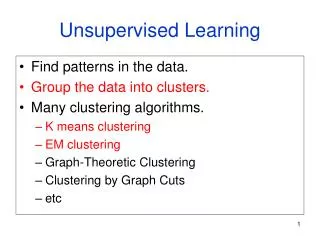
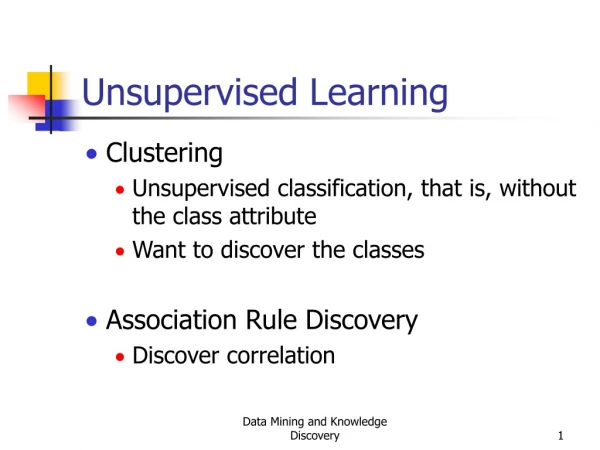
■ The operations involved require a high level of computational power and also take up a lot of time. Alternative to Unsupervised Learning: Semi-supervised learning may be a viable alternative to unsupervised learning. It is a combination or even a min-and-match of both unsupervised and supervised learning methods. The primary benefit of this sort of training would be that it lowers errors. For example, it will only cluster the unlabeled data that fits the clustering criteria, and it will categorise the output automatically once it has labels. This uses less computer power and takes less time. Types of Unsupervised Learning: Unsupervised learning problems are of two types. 1. Clustering Clustering is a method of grouping things together so that ones who have more in common stay in one group whereas others who have few or no in common stay in another. It classifies data into clusters based on common attributes. These models work by identifying similarities among data items and classifying them according to the presence or absence of such commonalities. Clustering Anomaly detection can help you find out if there are any unexpected data points in your collection. It’s important for detecting shady trades. Types of Clustering in Machine Learning
a. Exclusive clustering: Exclusive clustering is a type of clustering where a point can only be found in one cluster at a time. This type of grouping is often known as “hard” clustering. Exclusive clustering comprises the K-means clustering technique. b. Hierarchical clustering: Hierarchical clustering, commonly known as hierarchical cluster analysis (HCA), is an unsupervised clustering technique that may be divided into two types: agglomerative and divisive clustering. c. Agglomerative clustering: Agglomerative clustering is a “bottoms-up” technique to clustering. Its data points are first isolated as independent groups, then blended together repeatedly based on similarity until a single cluster is created. d. Probabilistic clustering: A probabilistic model is an unsupervised method for solving density estimation and “soft” clustering issues. Data points are grouped in probabilistic clustering based on the probability of belonging to a certain distribution. The Gaussian Mixture Model (GMM) is one of the most often used models. 2. Association Rule Mining: On the other hand, an association algorithm is a type of unsupervised learning approach for finding linkages between items in a large database. Identifies groupings of items in your collection that occur often together. The association rule
makes marketing efforts more successful. For example, sandwich spreads can be better marketed to people who have already bought butter. Types of Association Rule Mining a. Apriori: This algorithm uses frequent datasets to invoke association rules. It’s developed to work on the databases that bear transactions. This algorithm uses a breadth-first search and hash trees to compute itemsets efficiently. It’s primarily used for market basket analysis and helps to infer the things that can be purchased together. It also applies in the healthcare field to detect patient reactions to drugs. b. Eclat: Equivalence Class Transformation is the name of the Eclat algorithm. This approach finds common itemsets in a transaction database by using a depth-first search strategy. It executes quicker than the Apriori Algorithm. c. F-P Growth: The F-P growth algorithm is a new and upgraded version of the Apriori Algorithm. It is short for Frequent Pattern. It depicts the dataset as a frequent pattern or tree, which is a type of tree structure. This frequent tree’s goal is to extract the most recurring traits. Unsupervised Learning Algorithms
1. K-means Clustering K-means is a form of clustering method. It is a method of iterative clustering. According to this method, comparable points should be near together. For this, we shall choose a quantity for k. The number of observations is represented by the value of k. Select centroids from the data collection. The centroids will serve as data storage areas. Take each centroid and calculate the distance between k data points. Once reaching the centroid, they will get grouped. As measurement choices, we employ methods such as Euclidean distance. 2. KNN Clustering KNN, or K-nearest neighbour, is a clustering-based technique as well. This technique is used for data samples that may be allocated to any class or cluster, as well as those that do not have a category or group assigned. The algorithm begins with the determination of the area to be worked on. Then we must choose the k value, K will be the points surrounding the chosen spots. These points may belong to more than one cluster. Now, using Euclidean or Manhattan distance measurement methods, calculate the distance between each point and the test point. Arrange the data ascendingly. 3. Hierarchical Clustering In this case, we generate many clusters that are separate from one another, yet the contents of the clusters are substantially comparable. We would employ the distance matrix to calculate this, and then a dendrogram could be created to depict the groupings visually.
4. Agglomerative clustering Agglomerative clustering is the procedure of consolidating the groups. Each observation would be treated as a different group by the algorithm. Then it would locate and combine the two most comparable clusters. This procedure is repeated until all of the clusters have merged. The dendrogram is the major outcome. It would demonstrate the clusters’ commonality. There are various approaches for determining similarity, such as distance and connection factors. Applications of Unsupervised Learning: 1. Market Basket Analysis: One of the most well-known examples and uses of unsupervised learning is market basket analysis. Big merchants frequently employ this strategy to discover the relationship between goods. 2. Medical Diagnosis: Patients are treated quickly using association rules, since they assist in determining the likelihood of sickness for a certain ailment. 3. Marketing: Identifying groups of consumers that behave similarly, based on a big database of client data that includes their attributes and previous purchases helps to focus marketing efforts better. 4. Insurance:
Identifying groups of policyholders with a high average claim cost helps in detecting fraud. 5. Earthquake studies: Identifying risky zones by grouping together observed earthquake epicentres. Summary Unsupervised learning is a subtype of Machine Learning that draws inferences from data without labels or “guides”. This article has been an introduction to unsupervised learning, its types, its advantages, disadvantages and applications. We have also looked at some common algorithms and an alternative to unsupervised learning.