
Stream Processing with Proud: Java 8 Tutorial
Learn advanced stream processing in Java using the Proud framework, featuring methods for efficient data handling and manipulation. Discover various stream operations and examples from PJV04 and PJV25.

Stream Processing with Proud: Java 8 Tutorial
E N D
Presentation Transcript
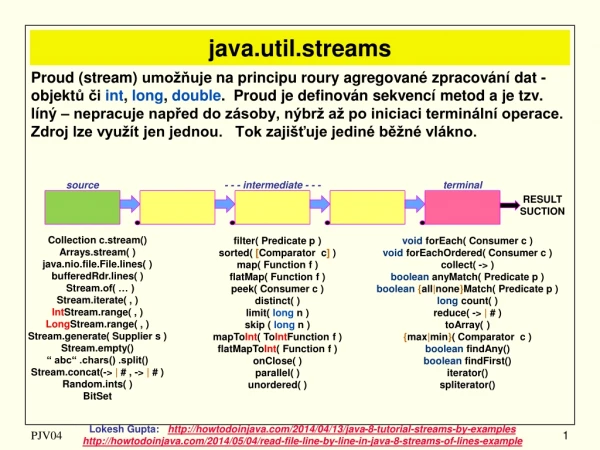
Proud (stream)umožňuje na principu roury agregované zpracování dat-objektů či int, long, double. Proud je definován sekvencí metod a je tzv. líný – nepracuje napřed do zásoby, nýbrž až po iniciaci terminální operace.Zdroj lze využít jen jednou. Tok zajišťuje jediné běžné vlákno. java.util.streams source - - - intermediate - - - terminal RESULT SUCTION Collection c.stream() Arrays.stream( ) java.nio.file.File.lines( ) bufferedRdr.lines( ) Stream.of( … ) Stream.iterate( , ) IntStream.range( , ) LongStream.range( , ) Stream.generate( Supplier s ) Stream.empty() “ abc“ .chars() .split() Stream.concat(-> | # , -> | # ) Random.ints( ) BitSet filter(Predicate p ) sorted( [Comparator c]) map( Function f ) flatMap( Function f ) peek( Consumer c ) distinct() limit(long n ) skip (long n ) mapToInt(ToIntFunction f) flatMapToInt(Function f) onClose( ) parallel( ) unordered( ) voidforEach(Consumer c ) voidforEachOrdered( Consumer c ) collect( -> ) booleananyMatch( Predicate p ) boolean{all|none}Match( Predicate p ) long count( ) reduce( -> | # ) toArray( ) {max|min}( Comparator c ) booleanfindAny() booleanfindFirst() iterator() spliterator() Lokesh Gupta: http://howtodoinjava.com/2014/04/13/java-8-tutorial-streams-by-examples http://howtodoinjava.com/2014/05/04/read-file-line-by-line-in-java-8-streams-of-lines-example PJV04
java.util.streams pro int/long/double BaseStream Stream Collector AutoCloseable <T,S..> <T> <T,A,R> Characteristics IntStream Stream Support Collectors + …… asDoubleStream() average() boxed() mapToLong( -> ) mapToObj( -> ) staticrange( , ) staticrangeClosed( , ) sum() summaryStatistics() toArray() static static …… stream( , ) intStream( , ) averagingInt( -> | # ) collectingAndThen( , ) counting() groupingBy( ) groupingByConcurrent( ) joining( ) mapping( , ) {max|min}By( ->| # ) partitioningBy( ) reducing( , ) summarizingInt( -> | # ) summingInt( -> | # ) toCollection(-> | # ) toConcurrentMap(-> | # ) toList() toMap(-> | # ) toSet() Int alter Long Double PJV04
.stream.BaseStream<T,S extendsBaseStream<T,S>> boolean isParallel( ) // static methods only Iterator<T> iterator( ) S onClose( Runnable closeHandler ) S parallel( ) S sequential( ) Spliterator<T> spliterator( ) S unordered( ) PJV25
Interfejs java.util.stream.Stream<T> 1/2 short circuitting je potomkemBaseStream<T, Stream<T>> static <T> Stream<T> concat( Stream<? extends T> a, Stream<? extends T> b ) static <T> Stream<T> empty( ) static <T> Stream<T> generate( Supplier<T> s ) static <T> Stream<T> iterate( T seed, UnaryOperator f ) s, f(s), f(f(s)), … static <T> Stream<T> of( T t ), of( T … values ) – hodnota či pole static <T> Stream.Builder<T> build( ) booleanallMatch( ), noneMatch( ), anyMatch( ) <R,A> R collect( Collector<? super T, R> collector ) long count( ) Stream<T> distinct( ) - propustí jenunikátníhodnoty Stream<T> filter( Predicate< ? super T > predicate ) Optional<T> findAny( ), findFirst( ) flatMap( … ) voidforEach( Consumer< ? super T > action ) PJV25
Interfejs java.util.stream.Stream<T> 2/2 Stream<T> limit( longmaxSize ) <R> Stream<R> map( Function<? super T,? extends R> mapper) IntStream mapToInt( ToIntFunction<? super T> mapper) Optional<T> max( ), min( ) Stream<T> peek( Consumer<? super T> action ) - pro diagnostiku Optional<T>reduce( BinaryOperator accumulator ) - kumulace T reduce( T identity, BinaryOperator accumulator ) Stream<T> skip(long n ) - přeskočení Stream<T> sorted( ), sorted( Comparator<? super T> comparator ) Object[ ] toArray( ) PJV25
java.util.stream. StreamSupport public final class StreamSupport { // static methods only IntStreamintStream( Spliterator.ofIntspliterator, boolean parallel ) IntStreamintStream( Supplier <? extendsSpliterator.ofInt> supplier, intcharacteristics, boolean parallel ) <T> Stream<T> stream( Spliterator<T> spliterator, boolean parallel ) <T> Stream<T> stream( Supplier <? extends Spliterator<T>> supplier, intcharacteristics, boolean parallel ) } PJV25
Finální třída java.util.stream.Collectors její statickémetody vracejí kolektory pro praktické redukční operace: <T> Collector<T, ?, Double> averagingInt( ToIntFunction<? super<T> mpr) <T> Collector<T, ?, Long> counting() collectingAndThen <T,K> Collector<T,?,Map<K,List<T>>> groupingBy(Function<? super T> Collector<CharSeq,?,String> joining( CharSequencedeleimiter ) <T,U,A,R> Collector<T,?,R> mapping(Function< > mpr,Collector<> stream) <T> Collector<T,?,Optional<T>> max/minBy(Comparator<? super T> cmp) <T> Collector<T,?,Map<Boolean,D>>partitioningBy(Predicate<?superT> p. <T> Collector<T,?,Optional<T>> reducing( BinaryOperator op ) <T> Collector<T,?,IntSum~> summarizingInt(ToIntFunction<? super<T> m) <T> Collector<T,?,Integer>summingInt(ToIntFunction< ? super T > mpr) <T,C extends Collection <T>>Collector<T,?,C>toCollection( Supplier<C ) <T> Collector<T,?,List<T>> toList(), toSet() toMap toConcurrentMap PJV25
Příklady Integer[ ] a = { 0,1,2,3,4,5,6,7,8,9 }; Stream<Integer> s1 = Stream.of( a );// proud z pole s1.sort( ).forEach( w -> { System.out.println(w); } ); // sort a výpis longcount = s1.collect( Collectors.counting( ) ); // počet položek Stream<Integer> s2 = Stream.of( a ).limit( 5 ); // jen prvních pět položek doubleavg = s2.collect( Collectors.averagingInt( x -> x ) ); // průměr Stream<Person> s3 = kolekceOsob.stream( ); // proud z kolekce doubleavg = s3.collect( Collectors.averagingDouble( p -> p.getPlat( ) ) ); List b = Arrays.asList( "A","BB","CCC" ); // tvorbakolekce Stream<String> s4 = b.stream( ); // proud z kolekce doubleavg = s4.collect( Collectors.averagingInt( String::length ) ); Optional w = b.stream( ).reduce( ( u, v) -> u=u+"-"+v); PJV04
Příklady vytvoření statistiky IntConsumerst = newIntSummaryStatistics( ); Integer[ ]a = { 0,1,2,3,4,5,6,7,8,9 }; for (intk : a) st.accept(k); Collection<Integer> b = Arrays.asList( 0,1,2,3,4,5,6,7,8,9 ); Spliterator<Integer> sp = b.spliterator( ); sp.forEachRemaining( st::accept ); Collector<Integer, ?, IntSummaryStatistics> coSt = Collectors.summarizingInt( x -> x ); IntSummaryStatisticsiss = b.stream( ).collect(coSt); Tisk vytvořené statistiky: System.out.println( b.stream( ).collect(Collectors.summarizingInt( x -> x ) ) ); PJV04
Příklad: statistika znaků List<String> Stream<String> IntStream String[] p={ "AAA", "BB", "C" }; int[] stat=newint[128]; Arrays.asList(p) // tvorba statistiky .stream().forEach( s -> s.chars().forEach(n-> stat[n]++)); for (int i = 0; i < stat.length; i++) // tisk statistiky if(stat[i]>0) System.out.println( (char)i+" "+stat[i]); PJV04
Příklad grouping a partitioning Budiž Collection col = Arrays.asList("A","BB","CCC","DDD","EE","F"); Stream<String> stream = col.stream(); Map<Integer, List<String>> map = stream .collect( Collectors.groupingBy( x->x.length( ) ) ); System.out.println(map ); // ~{ 1=[A, F], 2=[BB, EE], 3=[CCC, DDD] } Stream<String> stream = col.stream(); Map<Boolean, List<String>> map= stream .collect( Collectors.partitioningBy(t-> t.length( )%2==0)); System.out.println(map ); // ~{ false=[A, CCC, DDD, F], true=[BB, EE] } PJV04
Příklady redukce Budiž Collection col = Arrays.asList("A","BB","CCC","DDD","EE","F"); Stream<String> stream = col.stream(); Optional<Integer> opt = stream .map(t-> t.length()) .reduce( ( a, e ) -> a + e ); System.out.println( opt ); // ~ Optional[12] • OptionalInt opt = IntStream.iterate( 111, i -> --i ).limit( 5 ) .reduce( ( acu, elem ) -> Math.min( acu, elem ) ); System.out.println( opt ); // ~ Optional[107] System.out.println( IntStream.iterate( 1, i -> i+1 ).limit( 5 ) .reduce( ( a, e ) -> a * e ).getAsInt( ) ); // = 120 = 5 ! PJV04
Příklad konverze proudu a redukce ekvivalentní možnosti např. možnosti Stream<Integer> s=list.stream(); double result = s.filter( x -> true) // čirá propust .map(R -> ++R) // inkrementace hodnot .map( r -> new Double(r) ) .map( r -> Double.valueOf(r) ) // konverze do Double .map( r -> Double.valueOf ) .map(Double::new ) .collect( Collectors.summingDouble( Double::doubleValue ) ) ; .collect( Collectors.averagingDouble( r -> r.doubleValue() ) ); .collect( Collectors.averagingDouble( r -> r ) ); System.out.println( result ); PJV04
Příkladspliteratoru s externími zdroji ekvivalentní možnosti Stream<String> s= java.nio.file.File.lines(Paths.get(".", "data.txt")); newBufferedReader( newFileReader( "data.txt" ) ).lines( ); Spliterator<String> sp = s.limit( 42 ) // jentrochudat .spliterator( ); Cons cons = new Cons( ); // konzumující objekt while ( sp.tryAdvance( cons::accept ) ) ; class Cons implements Consumer<String> { public void accept( String t ) { System.out.print( t ); } } PJV04