Understanding Individualized Education Programs (IEP) for Students with Disabilities
Individualized Education Programs (IEP) are crucial legal documents required for each student with a disability. They outline the specific services provided to ensure that children receive Free Appropriate Public Education (FAPE). Developed according to set procedures, IEPs must be individualized and include key components such as present levels of performance, annual goals, and needed services. The IEP team typically comprises parents, educators, and specialists, ensuring a comprehensive approach that addresses the unique needs of each child, including transition planning and behavioral support strategies.


Understanding Individualized Education Programs (IEP) for Students with Disabilities
E N D
Presentation Transcript
IEP Lecture Notes
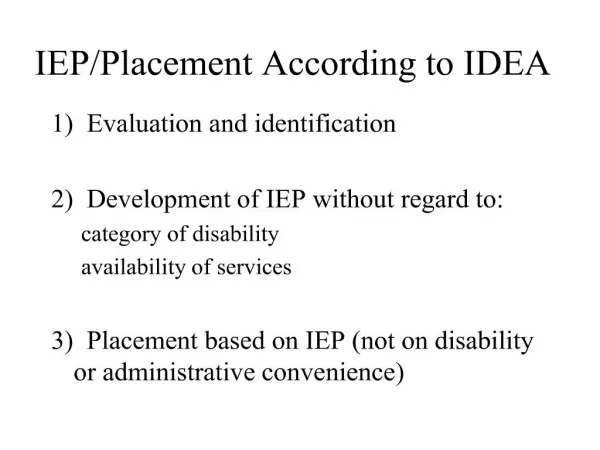
IEP • Required for each student with a disability. • Outlines services provided. • Assures that children with disabilities receive FAPE. • Developed in accordance with procedures. • Must be individualized.
Participants at Meeting • Child’s parents. • General education teacher. • Special education teacher. • LEA representative: • Qualified to provide or supervise provision of special education. • Knowledgeable about general curriculum. • Can commit resources.
Continued... • Person who can interpret the evaluation and instructional implications. • Others, at the discretion of parents and the school. • Child, when appropriate.
IEP Components • Present levels of performance • Annual goals • Benchmarks/short-term objectives • Special education services to be provided: • Related services • Supplementary aids and services • Program modifications
Continued... • Extent to which a child will not participate in general education. • Date for initiation, frequency, location and duration of services. • How progress toward goals will be measured and reported.
Continued... • Transition • Age 14: Needs focusing on child’s program of studies. • Age 16: Statement of needed transition services, including interagency responsibilities. • One year before maturity: Statement that child was informed of their rights.
Continued... • Modifications in administration of state and district assessments of student achievement. If student is not participating, you must tell why not and how achievement will be assessed.
In Developing • The team must include: • Strengths of the child. • Parent input. • Results of the most recent evaluation. • Child’s performance.
Other Factors • If behavior impedes the child’s learning, the team must consider positive behavioral interventions, strategies and supports to address that behavior. • Consider language needs, if limited English proficiency.
Continued... • For blind or visually impaired children, Braille instruction must be considered. • Communication needs of the child. • Appropriate assistive technology.