Download
1 / 1
10 likes | 208 Views
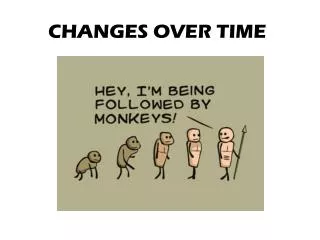
Connie Eble's 1996 study at the University of North Carolina revealed that college slang is highly transient, with only 10% of the lexicon remaining in use after seven years. Over a fifteen-year span, just four of two hundred words persisted. Eble's research shows that while some slang words vanish, others can transition into standard language, and a few maintain their popularity over time. This highlights the dynamic nature of language as it evolves in different eras. How has slang continued to change in recent years, and what might remain for the future?

E N D
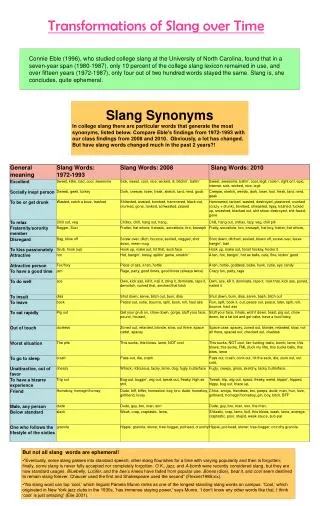
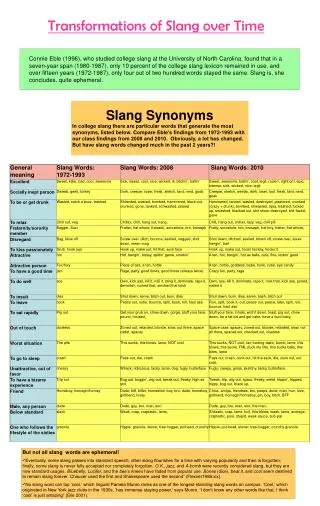
Transformations of Slang over Time Connie Eble (1996), who studied college slang at the University of North Carolina, found that in a seven-year span (1980-1987), only 10 percent of the college slang lexicon remained in use, and over fifteen years (1972-1987), only four out of two hundred words stayed the same. Slang is, she concludes, quite ephemeral. Slang Synonyms In college slang there are particular words that generate the most synonyms, listed below. Compare Eble’sfindings from 1972-1993 with our class findings from 2008 and 2010. Obviously, a lot has changed. But have slang words changed much in the past 2 years?! • But not all slang words are ephemeral! • “Eventually, some slang passes into standard speech; other slang flourishes for a time with varying popularity and then is forgotten; finally, some slang is never fully accepted nor completely forgotten. O.K., jazz, and A-bomb were recently considered slang, but they are now standard usages. Bluebelly, Lucifer, and the bee’s knees have faded from popular use. Bones (dice), beat it, and cool seem destined to remain slang forever. Chaucer used the first and Shakespeare used the second” (Flexner1986:xix). • “No slang word can top ‘cool,’ which linguist Pamela Munro ranks as one of the longest-standing slang words on campus. ‘Cool,’ which originated in New York jazz clubs in the 1930s, ‘has immense staying power,’ says Munro. ‘I don’t know any other words like that. I think ‘cool’ is just amazing” (Elie 2001).