Investigating Diagonals in Regular Polygons: Patterns and Formulas
In this study, we investigate the number of diagonals in various regular polygons, specifically those with 3, 4, 5, 6, 10, 15, and 35 sides. We use the formula for the number of diagonals, which is given by ( D = frac{n(n-3)}{2} ), where ( n ) is the number of sides. By applying this formula, we can observe patterns as the number of sides increases by 1. This analysis reveals the relationship between the number of sides and diagonals in regular polygons, highlighting how the number of diagonals grows with additional sides.

Investigating Diagonals in Regular Polygons: Patterns and Formulas
E N D
Presentation Transcript
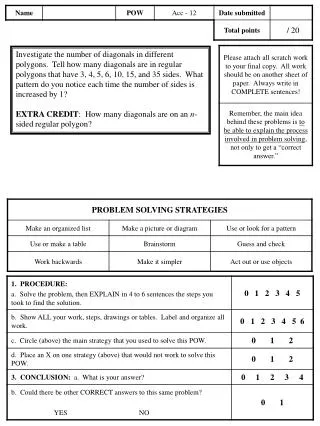
Acc - 12 Investigate the number of diagonals in different polygons. Tell how many diagonals are in regular polygons that have 3, 4, 5, 6, 10, 15, and 35 sides. What pattern do you notice each time the number of sides is increased by 1? EXTRA CREDIT: How many diagonals are on an n-sided regular polygon?