Download
1 / 17
170 likes | 300 Views
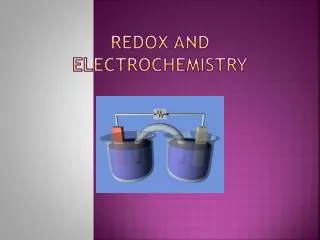
This guide provides a comprehensive overview of redox reactions and electrochemistry, explaining how to assign oxidation numbers to elements in various compounds, including binary and ternary compounds. It details the concepts of oxidation and reduction, the role of reducing and oxidizing agents, and the importance of conservation of mass and charge in redox reactions. Additionally, it introduces the fundamentals of electrochemical cells, distinguishing between spontaneous (galvanic) and non-spontaneous (electrolytic) processes, and examples such as the electrolysis of water.

E N D
Assigning oxidation numbers • Metals in group 1 have (+1) ox #, group 2 metals (+2) • Any single “Pure” element = 0 • Hydrogen is always (+1) except in metal hydride (-1) LiH 4. Oxygen is always (-2) exceptions: With flourine (flouide) +2 OF2 In Peroxides (-1) H2O2 • The sum of all oxidation #’s must = 0 • The sum of all Polyatomic ions must equal the charge of that ion
Assigning oxidation numbers • Binary Compounds _____ 1. Start with the Non Metal 2. Finish with the Metal HCl 3. Sum up must = 0 _______ MgCl
Assigning oxidation numbers • Ternary Compounds _____ 1. Start with the Non Metal (Oxygen) H2SO4 2. Go to the Metal (H) 3. finish up in the middle 4. Sum up must = 0 __________ Mg(NO3)2
Redox Reactions(reactions where both Oxidation and Reduction take place) The gain of Electrons Half Reaction 2e- + Mg+2 Mg0 (reactant) Loss of Electrons Half Reactions Mg0 Mg+2 + 2e- (product) Leo says ger Oil rig Causes the Reduction of the other elements Acts as a REDUCING AGENT (R.A.) Causes the other species to be Oxidized. Acts as the Oxidation Agent (O.A.) 1. Oxidation Reduction
Writing half reactionsdetermine the Ox / redra / oa Steps (Now this is Doc’s Method! …..Capisco?) 1. Assign the Ox #’s 2. Record the changes 3. Record e- loss / e- gain 4. Determine the species that is oxidized (RA) and reduced (OA) 5. Balance if unequal Ca + Cl2 CaCl2 ***HHH___ All Redox Reactions must demonstrate conservation of both Mass and Charge
Electrochemical cellSpontaneous cell (battery)Voltaic cell, galvanic cell(****Chemical energy electrical ****) Al Cu
Electrochemical cellSpontaneous cell (battery)Voltaic cell, galvanic cell
Electrochemical cellSpontaneous cell (battery)Voltaic cellgalvanic cell
Electrochemical cellSpontaneous cell (battery)Voltaic cellgalvanic cell
Electrochemical cellSpontaneous cell (battery)Voltaic cell, galvanic cell
Electrolytic cellnon-spontaneous cell (need a power source)electroplatingelectrolysis(****electrical chemical energy****)
Electrolytic cellnon-spontaneous cell (need a power source)electroplatingelectrolysis (****electrical chemical energy****)
Electrolytic cellnon-spontaneous cell (need a power source)electroplatingelectrolysis of water!!!
Electrolytic cellnon-spontaneous cell (need a power source)electrolysis of water!!! 2H2O 2H2 + O2
Electrolytic cellnon-spontaneous cell (need a power source)electroplatingelectrolysis of water!!!
Electrolytic cellnon-spontaneous cell (need a power source)(separation of a fused salt) 2NaCl 2Na + Cl2