Gas Laws
This guide provides a comprehensive overview of gas laws and their practical applications. It covers fundamental concepts such as pressure, volume, temperature, and the relationship between moles of gas. Key laws including Boyle's Law, Charles' Law, and Dalton's Law of Partial Pressures are explained alongside the Ideal Gas Law equation (PV=nRT). Additionally, standard pressure units like atmospheres, mmHg, and kPa are discussed, allowing for a complete understanding of gas behavior under various conditions. Essential for anyone studying chemistry or physics.


Gas Laws
E N D
Presentation Transcript
Factors • Pressure • Volume • Moles • Temperature
Pressure • Common units • Atmospheres (atm) • mm Hg • Torr • kiloPascals (kPa) • Pounds per square inch (psi) • Bar or millibar (b or mb) • Influences • Weight of air or water above you • Force caused by gas particle collisions with the container wall
Standard Pressure • 1 atm • 760 torr • 760 mmHg • 101.325 kPa • 14.69 psi
Volume • Typically in Liters • mL = cc or cm3
Moles • Gas laws are independent of mass, but are dependent on moles, which represents number of particles • Exception is Graham’s Law
Temperature • Must use Kelvins • K = oC + 273.16, but we can get away with saying 273
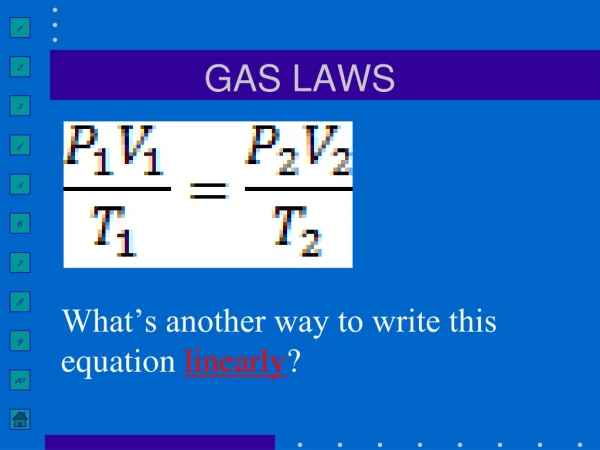
Dynamic gas Laws • PV/nT = PV/nT • Cross out any factors that are either constant or unmentioned • Use this only if a factor is changing
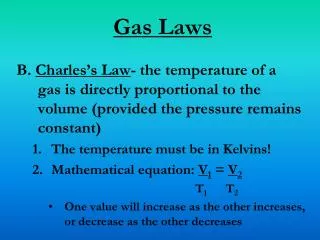
Individual Laws • Boyles Law PV • Charles’ Law VT • Avogadro’s Law Vn • Gay-Lussac: PT
Static Gas LawAKA Ideal Gas Law • PV=nRT • Use when you have all factors but one and the system is not changing • R = ideal gas constant • Values for R: depends upon your unit of pressure • 0.08206 L atm/mol K • 62.36 L mmHg/mol K • 62.36 L torr / mol K • 8.314 L kPa/mol K
Dalton’s Law of Partial Pressures • Pressure Tot = S partial pressure • Mole fraction = pressure fraction
Dalton’s law in gas collection over water • Pressure Tot = P coll gas+P water vapor • Total Pressure = atmospheric pressure • Water vapor pressure can be looked up in a table by temperature • Pressure of dry gas = Atmospheric pressure – water vapor pressure
Dalton’s Law with mole fraction • Have a mixture of 2 mol He, 4 mol Kr, and 4 mol Ar. If the total pressure is 760 mmHg, what is the partial pressure of Ar? • Mole fraction of Ar = 4/(2+4+4) or .4 • Partial pressure of Ar = 760 x .4 • Partial pressure of Ar = 304 mmHg
Graham’s Law • Two gases in a mixture are at the same temperature • Same temp means same avg kinetic energy • ½ mv2= ½ mv2 • The lower mass will have the higher velocity • A lower mass gas will diffuse or effuse faster
Gas Stoichiometry • May have to use PV=nRT to find moles of known or unknown • Be careful with your phase symbols. ALL gases must be considered