Effective Strategies for Paper 1-3 in History Exams
130 likes | 262 Views
This guide provides a structured approach to tackling history exam papers with a focus on Paper 1-3 formats. In Paper 1, manage your time efficiently with a 1-hour structure, addressing facts, meanings, and comparisons. For Papers 2 and 3, understanding the Cold War, single-party states, and key historical events is crucial. Emphasize strong thesis statements, organized body paragraphs, and conclusions that reflect your understanding of historiography and key concepts. Avoid prohibited topics, and incorporate diverse sources for a well-rounded perspective.


Effective Strategies for Paper 1-3 in History Exams
E N D
Presentation Transcript
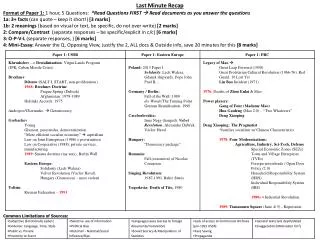
Last Minute Recap Format of Paper 1: 1 hour, 5 Questions: *Read Questions FIRST Read documents as you answer the questions 1a: 3+ facts (can quote – keep it short!) [3 marks] 1b: 2 meanings (based on visual or text, be specific, do not over-write) [2 marks] 2: Compare/Contrast (separate responses – be specific/explicit in c/c) [6 marks] 3: O-P-V-L (separate responses, ) [6 marks] 4: Mini-Essay: Answer the Q, Opposing View, Justify the 2, ALL docs & Outside info, save 20 minutes for this [8 marks] Common Limitations of Sources:
Papers 2 & 3:Approx. 5 minutes pre-writing, 40 minutes writing • Select the topics/Prompts that you can answer MOST SUCCESSFULLY • Paper 2: DO NOT WRITE ABOUT: Hitler, Mussolini or Franco! Do not select Korea/Vietnam Specific prompt • Paper 3: Do not select Canada • Pre-writing: ADDRESS THE TASK!!!! Plan Bodies, consider counter-arguments • Strong thesis in introduction: ADDRESS THE TASK!!!! • Bodies: Strong topic sentences, groupings based on task, key concepts, key figures, dates, events, and historiography • Conclusion; Strong, re-state thesis, acknowledge limitations and counter-arguments
Arguments & Counterarguments “It was personality and not circumstances that brought rulers of single-party states to power.” To what extent do you agree with this statement?
Cold War:Why did the end of the Second World War lead to the development of two superpowers and how did this development help to cause the Cold War?
What do I NEED to study? Paper 1 • Communism in Crisis: 1976-1989 • USSR & Eastern Europe: 1979-1991 • Eastern Europe: Poland, Czechoslovakia, Germany… • PRC: 1976-1989 • Format of Paper 1: • 1 hour • Questions: • 1a: 3+ facts • 1b: 2 meanings • 2: Compare/Contrast • 3: O-P-V-L • 4: Mini-Essay • Answer the Q • Opposing View • Justify the 2 • ALL docs & Outside info • Key Leaders • Key Policies/Doctrines • At least 3 (significant) dates • Key Vocabulary • Causes & Effects • Historiography?
What do I NEED to study? Paper 2 Single Party States: Cold War: Know Chronology!!! Origins of the Cold War: Ideology, Conferences US & USSR Foreign Policies (Doctrines) Regional Examples: Germany: Berlin blockade & airlift (1948-49), Berlin Wall (1961) 1950s Cuba: Castro, Revolution, Embargo, Bay of Pigs Invasion, Cuban Missile Crisis Korea & Vietnam: Proxy wars, policies Détente: 1960s & 1970s – change in policies and East/West relations START, SALT I End of the Cold War: 1989-1991 Eastern Europe Fall of Berlin Wall Collapse of USSR • At least 1 leader from each region • USSR (Europe): Lenin OR Stalin • PRC (Asia): Mao • Cuba (Latin America): Castro • Egypt (Europe): Nasser • DO NOT WRITE ABOUT: Hitler, Mussolini or Franco! • Rise to Power (including Ideologies) • Examples of Foreign & Domestic Policies • Successes & Failures • Global Impact • Dates • Historiography
Historiography – In General • Orthodox = Traditional Perspective • Soviet Orthodox = Pro-Communism • Western Traditional (aka Liberal)= Pro-Capitalism & Democracy • Orthodox View of Korean War in USA = War was justified • Orthodox view of Vietnam war in USA = War was a mistake • Revisionism & Post-Revisionism: • Revisionism: 1st time opposing or conflicting views emerge as legitimate • Post-Revisionism: Justifies both sides, possibly with new information • Ideology: • Marxist, Leninist, Stalinist, Cult of Mao, Arab Nationalist, Arab Socialist, Pan-Arabism • Archives: • USSR archives opening after fall 1989/1991 • PRC& Cuba = Still in control, keeps control of information • Egypt: Importance & translations of Arab documents = emerging field of study • USA = Declassified documents = freedom of information act • Sensitive info = still redacted
Historiography - Specific • USSR: • Pravda • Sheila Fitzpatrick, Robert Service, Orlando Figues • PRC: • The People’s Daily • Edgar Snow, Jonathan Spence, Chang & Halliday • Cuba: • Foreign Affairs Article Dominguez • Egypt: • Anthony Nutting, Robert Stephens, Eric Hobsbaum
What do I NEED to study? Paper 3 • Independence Movements • United States Civil War: causes, course and effects 1840‑77 • The Great Depression and the Americas 1929‑39 • Civil Rights and social movements in the Americas • ZINN!!!!