Download

1 / 16
160 likes | 279 Views
This overview explores the functional properties of neurons, including irritability and conductivity. Neurons respond to stimuli by transmitting nerve impulses, which differ from electric currents due to their slower conduction speed. The concepts of action potentials, depolarization, and the sodium-potassium pump are examined, as well as the faster saltatory conduction in myelinated neurons. The process of neurotransmitter release and synaptic transmission is explained, highlighting how neurons communicate across synapses. Key terms and mechanisms of nerve impulse propagation are illustrated for clarity.

E N D
Functional Properties of Neurons • Irritability – ability to respond to stimuli • Conductivity – ability to transmit an impulse
A nerve impulse does not flow like electricity because:1. Neurons conduct impulses at a slower rate than electric current 2. Neuron provides energy for transmission once it’s been stimulated. Wire is a passive conductor and requires a steady, outside energy source for continuous flow of electrons.
How can stimuli of different intensities be identified? Ex: light tap on arm vs. punch -vary the # of impulses sent -vary the # of neurons triggered (the speed & duration of nerve impulse is always the same) Characteristics of Nerve Impulses
What is saltatory conduction? -fastest method of nerve impulse conduction; nerve impulse jumps from one node of Ranvier to another; occurs only in myelinated neurons (like the difference between flying & driving) Characteristics of Nerve Impulses
See diagram & graph Transmission of a Nerve Impulse
Starting a Nerve Impulse • The plasma membrane at rest is polarized • Fewer positive ions are inside the cell than outside the cell
Starting a Nerve Impulse • Depolarization – a stimulus depolarizes the neuron’s membrane • A deploarized membrane allows sodium (Na+) to flow inside the membrane • The exchange of ions initiates an action potential in the neuron
The Action Potential (Nerve Impulse) • If the action potential (nerve impulse) starts, it is propagated over the entire axon • Potassium ions rush out of the neuron after sodium ions rush in, which repolarizes the membrane • The sodium-potassium pump restores the original configuration • This action requires ATP
Nerve Impulse Propagation • The impulse continues to move toward the cell body
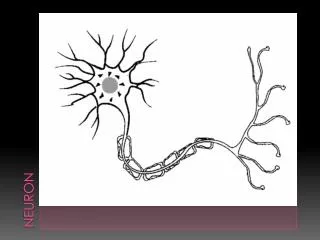
Continuation of the Nerve Impulse between Neurons • Impulses are able to cross the synapse to another nerve • Neurotransmitter is released from a nerve’s axon terminal • The dendrite of the next neuron has receptors that are stimulated by the neurotransmitter • An action potential is started in the dendrite
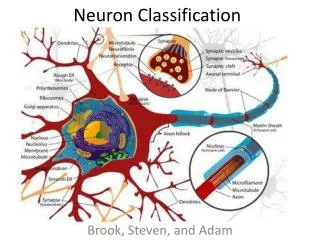
Synapse - a junction or gap between the axon of one neuron with the dendrites of another neuron Neurotransmitter - a chemical that changes the permeability of the cell membrane to a specific type of ion - initiates an action potential Ex: acetylcholine, serotonin, norepinephrine, GABA Diagram of Synaptic Transmission (synaptic cleft, vesicle, neurotransmitter, axon, dendrite, & receptor) Synaptic Transmission
animation/tutorial Synaptic Transmission