Effects of atSR45a Disruption on Chlorophyll Content and PSII Activity Under High-Light Stress
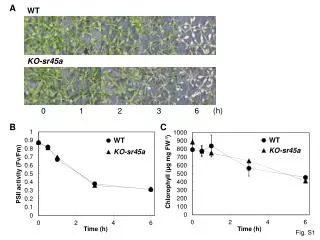
This study investigates the impact of disrupting atSR45a on chlorophyll content and PSII activity in Arabidopsis plants under high-light stress. Two-week-old seedlings were subjected to high-light intensity (800 µmol m-2 s-1) for 6 hours. Measurements were taken for PSII activity (Fv/Fm), chlorophyll content, and phenotypic changes in both wild-type and KO-sr45a plants. Results highlight significant differences in stress tolerance associated with atSR45a disruption, informing future research on plant stress responses.

Effects of atSR45a Disruption on Chlorophyll Content and PSII Activity Under High-Light Stress
E N D
Presentation Transcript
A WT KO-sr45a 6 (h) 0 1 2 3 B C Chlorophyll (µg mg FW-1) PSII activity (Fv/Fm) Time (h) Time (h) Fig. S1
Supplementary Fig. S1. Effects of disruption of atSR45a on high-light stress tolerance. Phenotypes (A), PSII activity (Fv/Fm)(B), and chlorophyll contents (C) of the wild-type and KO-sr45a plants under high-light stress. Two-week-old seedlings were exposed to high-light intensity (800 µmol m-2 s-1) for 6 h. The PSII activity (Fv/Fm) in the leaves of Arabidopsis plants was determined at 25˚C after adaptation to the dark for 30 min. Data are the mean ± SD for three individual experiments (n=3). FW, Fresh weight.