Download
1 / 7
70 likes | 189 Views
This guide explains the principles of probability and their application in genetics, particularly through Punnett squares. Probability helps us predict the outcomes of genetic crosses, allowing us to determine possible gene combinations from parental traits. The Punnett square is a visual tool that illustrates these combinations. It highlights the difference between homozygous (identical alleles) and heterozygous (different alleles) organisms, while also explaining phenotypes (physical traits) versus genotypes (genetic makeup). Learn how to utilize these concepts to understand genetic variation.

E N D
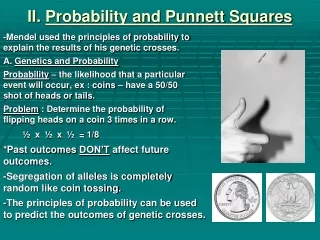
Genetics and Probability • The likelihood that a particular event will occur is called probability. • The principles of probability can be used to predict the outcomes of genetic crosses.
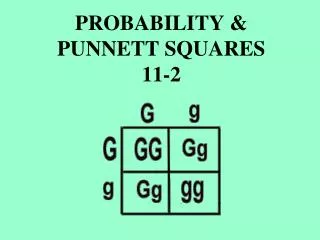
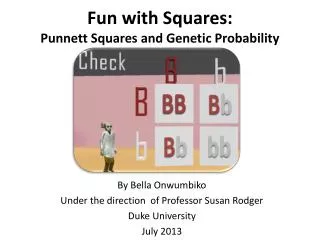
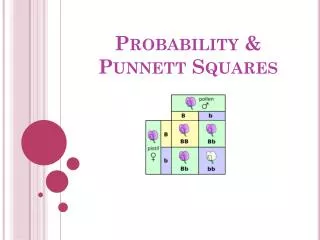
Punnett Squares • The gene combinations that might result from a genetic cross can be determined by drawing a diagram known as a Punnett square. • Punnett squares can be used to predict and compare the genetic variations that will result from a cross.
A capital letter represents the dominant allele for tall. • A lowercase letter represents the recessive allele for short. • In this example, • T = tall • t = short
Organisms that have two identical alleles for a particular trait are said to be homozygous. • Organisms that have two different alleles for the same trait are heterozygous. • Homozygous organisms are true-breeding for a particular trait. • Heterozygous organisms are hybrid for a particular trait.
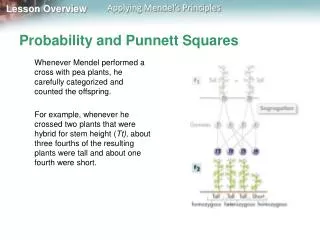
All of the tall plants have the same phenotype, or physical characteristics. • The tall plants do not have the same genotype, or genetic makeup. • One third of the tall plants are TT, while two thirds of the tall plants are Tt.
The plants have different genotypes (TT and Tt), but they have the same phenotype (tall).