Modeling Entorhinal-Cortex Control of Hippocampal Place Fields with Large-Scale Neuronal Networks
Recent discoveries about the entorhinal cortex-grid cell (EC-GC) populations suggest they significantly influence the stability and ignition of hippocampal CA1 place fields. This research explores the axial distribution of CA1 networks and their interaction with temporal lobe inputs to provide insights into visual navigation tasks. Utilizing in vitro recordings during behavior, we model these networks within the HRL SyNAPSE phase I hardware, expanding upon previously established RAIN networks and investigating the dynamics of place cell firing in large-scale compartmental neuronal models.

Modeling Entorhinal-Cortex Control of Hippocampal Place Fields with Large-Scale Neuronal Networks
E N D
Presentation Transcript
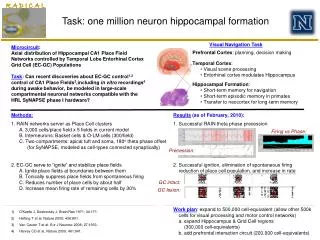
Task: one million neuron hippocampal formation Visual Navigation Task Microcircuit: Axial distribution of Hippocampal CA1 Place Field Networks controlled by Temporal Lobe Entorhinal Cortex Grid Cell (EC-GC) Populations Task: Can recent discoveries about EC-GC control1,2 control of CA1 Place Fields3,including in vitro recordings4 during awake behavior, be modeled in large-scale compartmental neuronal networks compatible with the HRL SyNAPSE phase I hardware? Prefrontal Cortex: planning, decision making • Temporal Cortex: • Visual scene processing • Entorhinal cortex modulates Hippocampus • Hippocampal Formation: • Short-term memory for navigation • Short-term episodic memory in primates • Transfer to neocortex for long-term memory • Methods:Results (as of February, 2010): • 1. RAIN networks server as Place Cell clusters 1. Successful RAIN theta phase precession • A. 3,000 cells/place field x 5 fields in current model • B. Interneurons: Basket cells & O-LM cells (300/field) • C. Two-compartments: apical tuft and soma, 180otheta phase offset • (for SyNAPSE, modeled as cell-types connected synaptically) • 2. EC-GC serve to “ignite” and stabilize place fields 2. Successful ignition, elimination of spontaneous firing • A. Ignite place fields at boundaries between them reduction of place cell population, and increase in rate • B. Tonically suppress place fields from spontaneous firing • C. Reduces number of place cells by about half • D. Increase mean firing rate of remaining cells by 30% Firing vs Phase: Precession: GC intact: GC lesion: • Work plan: expand to 500,000 cell-equivalent (allow other 500k cells for visual processing and motor control networks) • a. expand Hippocampus & Grid Cell regions • (300,000 cell-equivalents) • b. add prefrontal interaction circuit (200,000 cell-equivalents) O’Keefe J, Dostrovsky J. Brain Res 1971; 34:171. Hafting T et al. Nature 2005; 436:801. Van Cauter T et al. Eur J Neurosc 2008; 27:1933. Harvey CD et al. Nature 2009; 461:941.