Download
1 / 2
20 likes | 141 Views
Discover fascinating facts about Earth's climate, from the hottest regions near the equator to the coldest zones at the Poles. Learn about insolation, shadow lengths, surface colors, air pressure changes with altitude, and the composition of the air we breathe. Dive into meteorology and understand the dynamics of weather conditions in the troposphere.

E N D
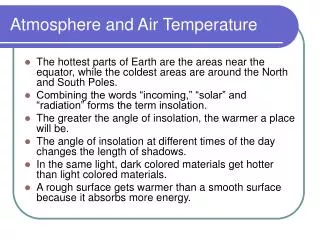
Atmosphere and Air Temperature • The hottest parts of Earth are the areas near the equator, while the coldest areas are around the North and South Poles. • Combining the words “incoming,” “solar” and “radiation” forms the term insolation. • The greater the angle of insolation, the warmer a place will be. • The angle of insolation at different times of the day changes the length of shadows. • In the same light, dark colored materials get hotter than light colored materials. • A rough surface gets warmer than a smooth surface because it absorbs more energy.
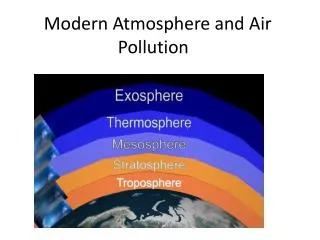
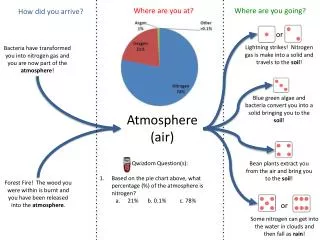
Atmosphere and Air Temperature • The troposphere is the lowest layer of the atmosphere. • As you go higher in altitude, air pressure falls (decreases). • Normal air pressure is greatest at sea level. • 99% of the air we breathe is a mixture of nitrogen and oxygen. Air also contains water vapor and dust particles. • “Weather” really describes what conditions are like in the troposphere at any given time and place.