Download
1 / 5
60 likes | 209 Views
Statistical natural language parsing faces challenges due to an exponential number of attachment ambiguities. Key parsing decisions are influenced by how constituents like prepositional phrases, adverbials, and infinitives are attached. The combinatorial nature of these attachments can be represented by Catalan numbers, illustrating the complex relationships and structures formed in language. This paper delves into two major problems: repetitive work in parsing and choosing the correct attachment, emphasizing the role of words as predictors, even without full context.

E N D
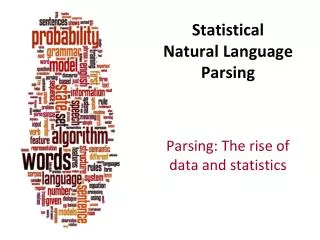
Statistical Natural Language Parsing An exponential number of attachments
Attachment ambiguities • A key parsing decision is how we ‘attach’ various constituents • PPs, adverbial or participial phrases, infinitives, coordinations, etc. • Catalan numbers: Cn= (2n)!/[(n+1)!n!] • An exponentially growing series, which arises in many tree-like contexts: • E.g., the number of possible triangulations of a polygon with n+2 sides • Turns up in triangulation of probabilistic graphical models….
Two problems to solve:2. Choosing the correct parse • How do we work out the correct attachment: • She saw the man with a telescope • Is the problem ‘AI complete’? Yes, but … • Words are good predictors of attachment • Even absent full understanding • Moscow sent more than 100,000 soldiers into Afghanistan … • Sydney Water breached an agreement with NSW Health … • Our statistical parsers will try to exploit such statistics.
Statistical Natural Language Parsing An exponential number of attachments