Download
1 / 14
140 likes | 255 Views
This project aims to bridge the gap between science, policy, and stakeholder engagement in Northern Australia’s irrigation sector. By providing new knowledge, tools, and processes, we support informed debate and decision-making amidst the increasing pressures on water resources. With collaboration from key partners including NAIF, SH, and UNESCO, we focus on promoting dialogue among farmers, bureaucrats, and policymakers. Our outcomes include improved understanding of northern water systems, centralized data access, and strengthened stakeholder networks for effective irrigation management.

E N D
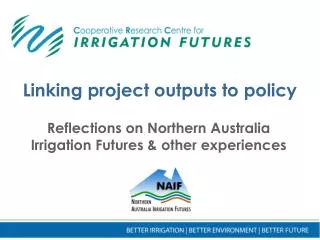
Linking project outputs to policy Reflections on Northern Australia Irrigation Futures & other experiences
Northern Australia Irrigation Futures GOAL: To provide new knowledge, tools and processes to support debate and decision making regarding irrigation in northern Australia CORE PARTNERS:
NAIF = SH = UNESCO HELP “Promoting dialogue between scientists, policymakers & stakeholders”
How well do you understand the policy making environment? • Farmers • Irrigation companies • Bureaucrats • Politicians
Understanding the broad context “…the three jurisdictions of the north – QLD, NT & WA – are facing increasing pressures to free up water for development, but the risk is that they lack sufficient knowledge of their rivers & groundwater systems to respond with confidence.” David Trebeck, Commissioner, NWC, Dec. 2006
What impacts on confidence? Decisions about irrigation development are very complex + Lots of uncertainty + High risks & consequences + Increasing pressure on northern land and water resources + Higher community expectations and informed watchdogs + Governments will need to continue to make decisions = Often risk averse Wouldn’t you be?
Policy and decision makers are under pressure like everyone else “Resource decisions are often made with whatever information is readily at hand, regardless of whether it represents a full & accurate picture” (Oregon Coastal Atlas, 2005)
The question is the same: How can we help? Must dealing with complexity result in more so called ‘red tape’? There are many uncertainties, but is every uncertainty a high risk?
Is doing more research the only answer? “While a mass of information and data is available on various aspects of irrigation and irrigation management, it is often scattered across industries or locations or websites and is difficult to access… Critically, this lack of accessible, centralised information leads to inappropriatemanagement practices or duplication of research and resources.” (ANCID, July 2007)
NAIF Outputs / Outcomes • Project reports / scientific papers • Improved understanding of northern systems • QLD, NT, WA and Australian water departments (and others) working together • Forum for Taskforce to connect with northern Australian governments • Growing network of more informed stakeholders • Technology / processes to support irrigation decision making
Reflections on the NAIF approach • Policy makers have actively guided project direction, have a sense of ownership and team commitment • The process is at least as valuable as project outputs • Good relationships demand trust, trust takes time • Including science and policy / management skills in one project has been “highly successful” • NAIF would not exist now without the value set of the researchers
A few other reflections • Bureaucrats are not the government, they are instruments of it • Cultivate relationships with political advisors • Collect practical stories and tell them • Don’t expect policy makers to have all the policy solutions, suggestoptions • Developing potential pathways to adoption may require tenacity, but it is our responsibility.
THIS SLIDE IS NOT TO BE USED IN THE PRESENTATION Please copy relevant logos from below and paste at the base of the title slide. Delete this slide from the presentation once complete.