Download

1 / 22
220 likes | 346 Views
Dive into the fascinating world of capacitors with this comprehensive course. Explore key concepts, including dielectric materials, Gauss's Law, and the significance of capacitor charging and discharging in RC circuits. Engage with quizzes, unit completion tasks, and hands-on lab reports to reinforce your understanding. Prepare for the upcoming examination on units 4-9 as you learn how to measure capacitance and the effects of different dielectrics. Whether you're returning from spring break or just getting started, this course equips you with the knowledge to excel in the unit on magnetism that follows.

E N D
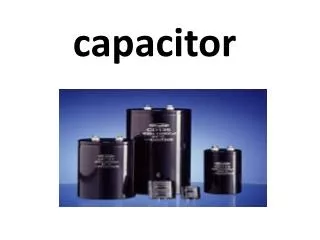
Ye olde capacitor8.3 InstructorCourse
Today & Beyond • Quiz • Material on Capacitors not in the unit. • Complete the unit (9) • SPRING BREAK • RETURN • Monday – Begin Unit on Magnetism. (Bring to class) • Wednesday – EXAMINATION #2 / Bring in units 4-9 / Lab Reports Due. • Friday – Continue magnetism unit.
What is the current through the 4- resistor in this circuit? a) 0.67 A b) 0.75 A c) 1.0 A d) 1.5 A e) 4.5 A Text Answer
What's Happening? DIELECTRIC
Apply an Electric Field Some LOCAL ordering Larger Scale Ordering
Adding things up.. - + Net effect REDUCES the field
We can measure the C of a capacitor (later) C0 = Vacuum or air Value C = With dielectric in place C=kC0
Recall the experiment – • Voltage across C seemed to drop rather than stay stable. • You were given a second capacitor and it held it’s value. • What’s going on??? • meters have resistors of 1-10MW
20.13 RC Circuits Capacitor charging time constant
20.13 RC Circuits Capacitor discharging time constant
Stored Energy • Charge the Capacitor by moving Dq charge from + to – side. • Work = Dq Ed= Dq(V/d)d=DqV
A Thunker Find the equivalent capacitance between points a and b in the combination of capacitors shown in the figure. V(ab) same across each