Rhythm
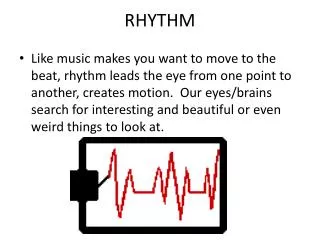
Rhythm. Chapter 3. Rhythm. What is Rhythm?. Rhythm is basic to life!. Rhythm. We see it in the cycle of day and night! The four seasons Rise and fall of the tides Heartbeats Breathing Walking Rhythm is the life-blood of music!. Rhythm definition.

Rhythm
E N D
Presentation Transcript
Rhythm Chapter 3
What is Rhythm? Rhythm is basic to life!
Rhythm • We see it in the cycle of day and night! • The four seasons • Rise and fall of the tides • Heartbeats • Breathing • Walking Rhythm is the life-blood of music!
Rhythm definition • Rhythm is the flow of music through time • Recurring pattern of tension and release. • Expectations and fulfillment
When you Clap Your Hands or Tap Your Feet… • You are responding to the beat!
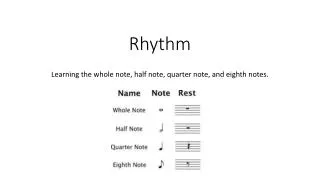
Beat • The Beat is a regular, recurrent pulsation that divides music into equal units of time • Beats form the background against which a composer places notes of varying length, and are the basic unit of time by which all notes are measured. • Some beats feel stronger or more stressed (more empasized)
Meter • The organization of beats into regular groups. • A group containing a fixed number of beats is called a measure. • The first, or stressed, beat of the measure is called the downbeat.
More About Meters • When a measure has 2 beats…we call this duple meter. “Twinkle, Twinkle…” Duple meters can be found in marches…”one, two, one, two…” “Left, Right….” • Triple Meter is three beats to a measure and is traditionally found in waltzes. • Quadruple Meter – is Common Time, 4 beats to a measure. Primary accent on ONE, Secondary on THREE.
More Meters? • Sextuple or six beats per measure. “Oh give me a home…..”
Accent and Syncopation • An accent is played more loudly than the notes around it! • When an accented note comes where we would normally NOT expect it, the effect is known as syncopation. A syncopation occurs when an “offbeat” note is accented (that is when the stress comes between the beats). “Give my regards to Broadway….” • Throws of the regular pattern!
Tempo • The speed of the beat. The basic pace of the music. • We associate tempos with drive, energy, and excitement. Slow tempos are solemn, lyrical or calm.
Term Meaning • Largo very slow, broad • Grave very slow, solemn • Adagio slow • Andante moderately slow, walking • Moderato moderate speed • Allegretto moderately fast • Allegro fast • Vivace lively • Presto very fast • Prestissimo as fast as possible
Other Tempo terms • Molto – much • Non troppo – not too much • Accelerando – becoming faster • Ritardando – becoming slower • Metronome – a device that ticks or flashes a light at any desired musical speed. The metronome setting indicates the exact number of beats per minute.
Melody • A series of single notes that add up to a recognizable whole • A melody begins, moves and ends! • It has direction, shape, and continuity. • The up and down movement of its pitches conveys tension and release, expectation and arrival. • This is the melodic curve, or line. • A melody moves by small intervals called steps or larger one called leaps. • Often the highest tone of a melody is called the climax.
Melody • Note durations contribute to the distinctive character of a melody. Long and short notes. • Legato is a connected style and staccato is a detached style. • Melodies are made up of phrases. Lets say that these are the sentences in a story. • Phrases may have a pattern…similar pitch and rhythm patterns that help unify the melody. • A sequence is a repetition of a melodic pattern at a higher or lower pitch.
Cadence • A resting place at the end of a sentence-a point of arrival! • A Cadence may be partial, setting up expectation or it may give a sense of finality.