Download
1 / 16
160 likes | 263 Views
This study models low-energy impacts on feedback Beam Position Monitors (BPMs) in TESLA IR, comparing Geant Monte Carlo packages at low energies and experimental tests at SLAC ESA. The simulation includes impacts on BPM performance and provides insights into detector backgrounds for future experiments.

E N D
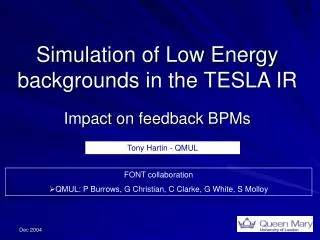
Simulation of Low Energy backgrounds in the TESLA IR Impact on feedback BPMs Tony Hartin - QMUL • FONT collaboration • QMUL: P Burrows, G Christian, C Clarke, G White, S Molloy
Talk Outline • Model feedback BPMs in Geant description of TESLA IR • Geant mods for low Energy transport • Compare Monte Carlo packages (Geant3,Geant4, EGS) at low energies • BPM experimental tests at SLAC ESA
FONT elements - BPM • BPM provides input to beam based feedback system (see Phil’s talk) • Incident impacts on BPM affect performance BPMs sited behind masks
BPM performance • 4 Copper strips in total • Susceptible to noise from absorbed charge and secondary emission F(R,Solid Angle,bunch charge) • 1pm error for each charge absorbed or emitted. 1e6 hits per b.c. would be a problem! • low energy impacts affect strip charge
Geant 3 model • IR model adopted from Brahms • Strips placed on the wall of the beampipe • Guinea-Pig pair particles and photons tracked with different kinetic energy cuts • 4 Tesla Magnetic Field included as per Brahms default 10 cm Cu strips
BPM hits • Single 12 Gev e+ • Multiple hits through showering • Origin of hits: • Inner beampipe • Cylindrical mask • Calorimeter • 20% direct hits from IP
Energy spectrum of BPM hits • Geant3 energy cuts for particle transport – default 1 MeV - minimum 10 k.e.cut • BUT.. at least half the BPM hits have k.e between 10 keV and 1 MeV • AND.. Eg e-/+ hits of just a few eV ionize BPM strips
Transport Code Low E cuts • Geant3 • 1 MeV default, 10 keV min • Low E recode to 100eV • Computing time – 1 week per b.c. • Runs much faster than G4! • . • 1 keV minimum • LowE package available -> 250eV • EGS • EGSnrc - 1 keV minimum • KEK (low-energy)Extensions to EGS4 100 eV
Geant3/4 mod for Low Energy Transport • Geant3 X-section parametrization wrong below 10kev cut • Recode Geant3 to parametrize real data from NEA site • Similar schemes • Apostolakis 1999, Geant4 LowE • Kippen, New Astr Rev (2004) • Y. Namito and H. Hirayama, KEK Internal 2000-4
Road test lowE mods – Copper disc model • Fire 100 identical Incident electrons at Cu strip • Emergent flux for different E cuts • LowE mods reveal more secondaries
Geant 3 recoding sanity checks -Cu disc model • Fire 100 identical Incident electrons at Cu strip • Emergent flux for different E cuts • LowE mods reveal more secondaries
Geant3 total BPM hits - lowE • lowE mods reveal significant increase in BPM hits at 100eV cut • 6000 hits per strip per b.c NOT in the danger zone • G4 lowE secomdaries indicate the number of hits is probably greater • Neutron impacts not yet considered
Detector BKG (NLC) F.O.N.T. G.R.White: 11/09/2014 • Insertion of feedback system at z=4.3 m has no impact on secondary detector backgrounds arising from pair background • Past studies suggest backgrounds adversely effected only when feedback system installed forward of z=3 m
Possible experimental tests at SLAC-ESA(Christian/Clarke) • Possible test of BPM performance at ESA with expected pair background at ILC – use radiator at ESA to mimic ILC pair background • 2 options – Thin target (~5-10% X0) in IR-mockup at ESA or Thick target (~30% X0) at end of linac to produce secondary spray beam in A-line • Built simple GEANT3 model for thin target option • First-step – benchmark model against EGS simulation of Keller/Woods for thin radiator
Comparison of GEANT/EGS models – first results GEANT model 1 million incident electrons @25 GeV 10% X0 carbon radiator #particles E>500KeV hitting scoring plane 3m from target EGS model (Keller)
Future Plans • Convert TESLA IR + feedback BPMs from Geant3 -> Geant4 • Compare low Energy performance of EGS, Geant4 and Geant3-mod • Gauge impact of crossing angle and other suggested TESLA IR mods