Overview of Voltaic Cell: Reactions and Electron Flow Animation
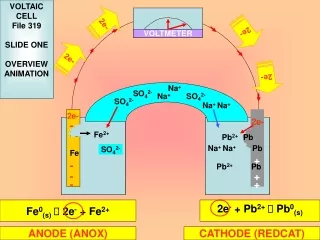
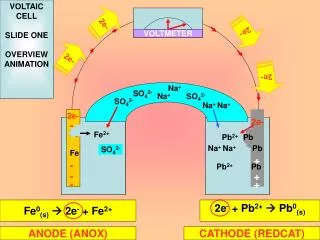
This animation illustrates the functioning of a voltaic cell, showcasing the reduction and oxidation processes at both the anode and cathode. As iron is oxidized at the anode (losing mass and electrons), positively charged iron(II) ions enter the solution. Electrons flow through a voltmeter to the cathode, where lead(II) ions are reduced to solid lead, showcasing electroplating. The movement of positive salt ions through the salt bridge helps to maintain charge balance. Gain insights into the fundamental concepts of electrochemistry through this engaging animation.

Overview of Voltaic Cell: Reactions and Electron Flow Animation
E N D
Presentation Transcript
VOLTAIC CELL SLIDE ONE OVERVIEW ANIMATION 2e- 2e- VOLTMETER 2e- 2e- Na+ SO42- Na+ SO42- SO42- Na+ Na+ 2e- Fe Fe Pb 2e- - Fe2+ Pb2+ Pb Na+ Na+ SO42- + - Pb2+ Pb - + - + Fe0(s) 2e- + Fe2+ 2e- + Pb2+ Pb0(s) ANODE (ANOX) CATHODE (REDCAT)
VOLTAIC CELL SLIDE TWO THE ANODE AS THE Fe(S) IS OXIDIZED, IT DISSOLVES AND THE ANODE LOSES MASSAND 2e- ARE RELEASED AS THE Fe(S) IS OXIDIZED, IT DISSOLVES AND THE ANODE LOSES MASS, THE IRON(II) IONS WILL MAKE THE ANODE SOLUTION POSITIVE, THEREFORE THE NEGATIVE SALT BRIDGE ION MOVES IN TO NEGATE THE + CHARGE VOLTMETER Na+ SO42- Na+ SO42- SO42- Na+ Na+ 2e- Fe Fe Pb Fe2+ NSBTA Negative salt bridge to anode Never sell booze to adolescents! SO42- Pb2+ Pb Fe0(s) 2e- + Fe2+ 2e- + Pb2+ Pb0(s) ANODE (ANOX) CATHODE (REDCAT)
VOLTAIC CELL SLIDE THREE e- FLOW 2e- 2e- VOLTMETER 2e- 2e- ELECTRONS ALWAYS MOVE FROM ANODE TO CATHODE (FATCAT). THE ELECTRONS BUILD UP IN THE ANODE MAKING IT NEGATIVE, TRAVEL TO THE CATHODE WHERE A METAL ION GAINS THEM IN REDUCTION, THE CATHODE IS POSITIVE. VOLTMETER ALWAYS POINTS TO CATHODE, Na+ SO42- Na+ SO42- Na+ Na+ 2e- Fe Fe Pb 2e- Fe2+ SO42- Pb2+ Pb Fe0(s) 2e- + Fe2+ 2e- + Pb2+ Pb0(s) ANODE (ANOX) CATHODE (REDCAT)
VOLTAIC CELL SLIDE FOUR THE CATHODE 2e- 2e- VOLTMETER 2e- THE POSITIVE SALT ION MIGRATES TO THE CATHODE TO REPLACE + CHARGE LOST AS Pb(II) ARE REDUCED TO Pb SOLID. 2e- THE SOLID LEAD BONDS (METALLIC BONDING) THE CATHODE WHICH GAINS MASS. THIS IS ELECTROPLATING. Na+ SO42- Na+ SO42- SO42- Na+ Na+ 2e- Fe Fe Pb 2e- Fe2+ Pb2+ Pb Na+ Na+ SO42- AS ELECTRONS ARE GAINED BY Pb(II) IONS FROM THE CATHODE, THE IONS BECOME REDUCED INTO Pb(S) Pb2+ Pb Fe0(s) 2e- + Fe2+ 2e- + Pb2+ Pb0(s) ANODE (ANOX) CATHODE (REDCAT)