Strategies for Reducing Sediment Yield and Enhancing Watershed Management
This comprehensive project focuses on establishing effective reduction targets for sediment yield in selected watersheds. By developing and delivering an outreach plan, it aims to engage farmers and stakeholders in conservation practices that enhance water quality. Key components include monitoring sediment levels, refining the on-line HIT system, and gathering user feedback through a Technical Advisory Committee. Ongoing analyses will evaluate best management practices (BMPs) and farmer participation, identifying high-risk erosion areas and optimizing outreach effectiveness for improved environmental stewardship.

Strategies for Reducing Sediment Yield and Enhancing Watershed Management
E N D
Presentation Transcript
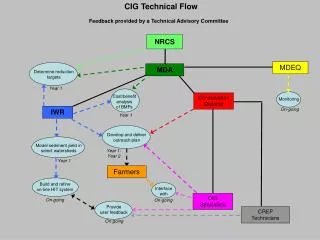
CIG Technical Flow Determine reduction targets Develop and deliver outreach plan Monitoring Model sediment yield in select watersheds Build and refine on-line HIT system Interface with Provide user feedback Feedback provided by a Technical Advisory Committee NRCS MDEQ MDA Year 1 Cost/benefit analysis of BMPs Conservation Districts On-going IWR Year 1 Year 1-Year 2 Year 1 Farmers CIG Specialists On-going On-going CREP Technicians On-going
Other inputs Water quality info Estimate levels of farmer participation Identify high risk erosion areas Composition of Advisory Committee and Planned Inputs Representatives of MACD Farm Bureau MDEQ IWR Watershed Orgs MDNR FSA NRCS MSUE Advisory CommitteeInputs MDA Identify Targeted Sub-watersheds
HIT utility Outreach effectiveness Modeling improvements Composition of IWR Technical Committee Representatives of CIG Specialists MACD Farm Bureau Watershed Orgs FSA NRCS MSU Ag Engineering MDA CREP Technicians Technical CommitteeInputs IWR Ease of system use Refine and enhance HIT technical capacity
Quantify reductions in sediment loadings Estimate long term water quality improvements Number of farmers and organizations receiving conservation education Participants and enrolled acres as a % of potential participants and acres Unique hits on HIT website CIG Program Evaluation MDA Conservation Districts IWR MDEQ Provides