Download
1 / 5
50 likes | 157 Views
Explore key issues in trunk group communication over SIP, including SIP vs. tel URIs, global vs. local namespaces, and handling originating and destination trunk groups effectively in SIP messages.

E N D
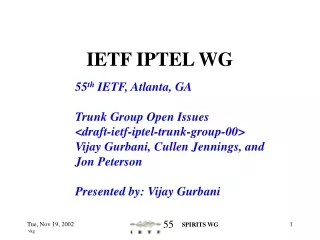
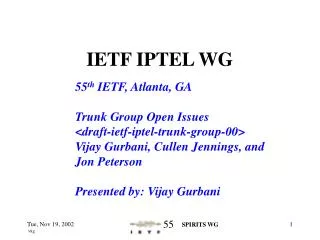
IETF IPTEL WG 55th IETF, Atlanta, GA Trunk Group Open Issues <draft-ietf-iptel-trunk-group-00> Vijay Gurbani, Cullen Jennings, and Jon Peterson Presented by: Vijay Gurbani
Issues • Issue 1: “sip” URI or “tel” URI? • Defining them as extensions to the “tel” URI appears reasonable (since trunks are tied to the PSTN, anyway). • Easy to derive a SIP URI from the tel URI.
Issues • Issue 2: Global or local namespace? • Most trunk groups will be locally scoped; however, for the sake of flexibility, a naming convention has been proposed in the I-D which is flexible enough to accommodate both. • ABNF has been proposed in the I-D for this purpose, resulting in a URI which may look like: • tel:+14085551212;tgrp=local=tg55/3
Issues • Issue 3: Originating and destination trunk groups should be able to appear separately and concurrently in the SIP message. • Originating trunk group: Contact header • Destination trunk group: R-URI • Other options: • Originating trunk group: From header (abstract identifier that persists even after the session is completed – probably not a good choice). • Destination trunk group: To header (same reservation as above, plus, proxies make routing decisions based on R-URIs).
Issues • Issue 4: SIP intermediaries should be able to add the destination trunk group to SIP requests as a route is selected for the session. • Argues more in favor of using R-URI.