Understanding Viruses: Structure, Life Cycle, and Retroviruses
Viruses are noncellular particles comprising genetic material that invade living cells, classified as non-living due to their absence of metabolism and cell structure. They are tiny and typically specific to host cells. A virus contains a core of genetic material (either DNA or RNA) encased in a protein coat called a capsid. The life cycle includes lytic and lysogenic infections, which involve the virus attaching to host cells, injecting its genetic material, and either destroying the host cell or integrating into its DNA. Retroviruses, such as HIV, use reverse transcription to convert RNA into DNA.

Understanding Viruses: Structure, Life Cycle, and Retroviruses
E N D
Presentation Transcript
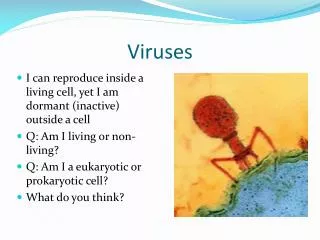
Viruses • Virus: A noncellular particle composed of genetic material that can invade living cells. • Viruses are considered by most to be non-living since they lack metabolism and are not made of cells. • Are extremely small • Are usually very specific as to what cells they can invade
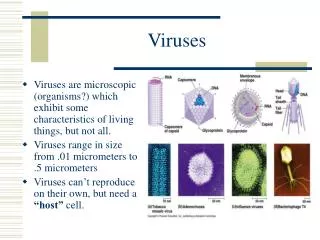
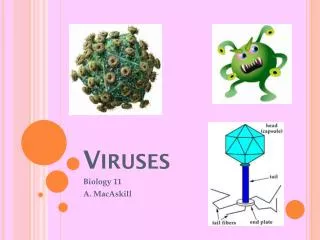
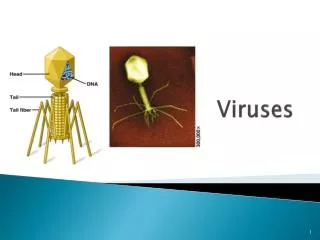
Structure of a Virus: • Contain core of genetic information (either DNA or RNA). • Genetic material surrounded by a protein coat called a capsid.
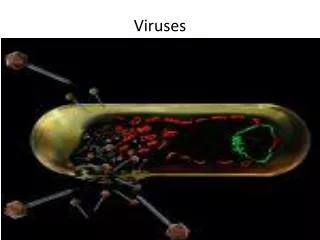
Life Cycles of virusesLytic infection: Infection: Virus identifies an attaches itself to a host cell. The genetic material is then injected into the host cell. • Growth: Genetic material of virus overrides host cell's activities. Cell is now instructed to replicate viral genetic material and protein coats. • Lysis: Cell is lysed "broken open" and new viruses are released to infect other cells. This kills the host cell
Life Cycles of virusesLysogenic infection: • Similar to lytic infection however important differences exist • Instead of immediately replicating, viral DNA incorporates itself into the host cell's DNA. • Will remain dormant for significant amounts of time. • Give certain conditions, the virus will enter it's lytic phase similar to a normal lytic infection
Retroviruses • A new form of virus has been identified known as a retrovirus. • Retroviruses are RNA viruses which can conduct a process known as Reverse Transcription • In reverse transcription RNA is used to make DNA (the reverse of the normal RNA transcription process). • HIV is a retrovirus.