Understanding Atoms: The Building Blocks of Matter
This presentation explores the fundamental concept of atoms, the smallest units of matter. It explains that all matter, whether solid, liquid, or gas, is composed of atoms, which are categorized into different elements. Discover sub-atomic particles, including protons, neutrons, and electrons, as building blocks of atoms. Using the beryllium and lithium elements as examples, learn to identify atomic numbers, chemical symbols, names, and atomic masses. This engaging overview provides crucial insights into the building blocks of our universe.

Understanding Atoms: The Building Blocks of Matter
E N D
Presentation Transcript
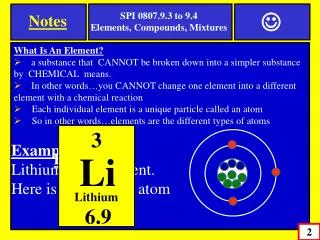
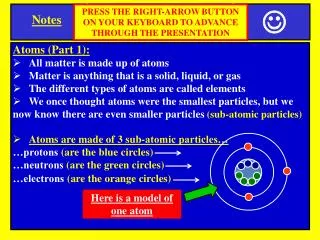
PRESS THE RIGHT-ARROW BUTTON ON YOUR KEYBOARD TO ADVANCE THROUGH THE PRESENTATION SPI 0807.9.1 Atoms Notes • Atoms (Part 1): • All matter is made up of atoms • Matter is anything that is a solid, liquid, or gas • The different types of atoms are called elements • We once thought atoms were the smallest particles, but we • now know there are even smaller particles (sub-atomic particles) • Atoms are made of 3 sub-atomic particles… • …protons (are the blue circles) • …neutrons (are the green circles) • …electrons(are the orange circles) Here is a model of one atom
Notes SPI 0807.9.1 (Atoms) • Below is a model of one beryllium atom • Notice that is has 4 (blue) protons • So the atomic number is four • Notice that it also has 4 (orange) electrons 1 Legend 3 2 =protons 1 4 3 2 =neutrons =electrons 4
HINT: Look at the top/right of p286 to see how to read the periodic table. HINT: The atomic number is the number of protons! SPI 0807.9.1 (Atoms) SPI 0807.9.9 (Per Table) Notes • What is this element’s atomic number • Write it down! • ANSWER: Atomic number is 3 because it has 3 (blue) protons 3 Li Lithium 6.9
HINT: Look at the top/right of p286 to see how to read the per table SPI 0807.9.1 (Atoms) SPI 0807.9.9 (Per Table) Notes • What is this element’s chemical symbol • Write it down! • ANSWER: Chemical symbol is Li 3 Li Lithium 6.9
HINT: Look at the top/right of p286 to see how to read the per table Notes SPI 0807.9.1 (Atoms) SPI 0807.9.9 (Per Table) • What is this element’s name? • Write it down! • ANSWER: Element name is lithium 3 Li Lithium 6.9
HINT: Look at the top/right of p286 to see how to read the per table SPI 0807.9.1 (Atoms) SPI 0807.9.9 (Per Table) Notes • What is this element’s atomic mass. • Write it down! • ANSWER: Atomic mass is 6.9 3 Li Lithium 6.9