Understanding Trees and Spanning Trees in Graph Theory
This article explores the definition and properties of trees in graph theory, highlighting their characteristics such as being connected graphs with no cycles and having |V|-1 edges. It also covers the concept of spanning trees, including methods to count them and the importance of minimum weight spanning trees. We discuss Kruskal’s algorithm as an efficient method for finding minimum spanning trees, detailing the required steps including sorting edges and using union-find techniques. This guide is essential for understanding fundamental graph concepts.

Understanding Trees and Spanning Trees in Graph Theory
E N D
Presentation Transcript
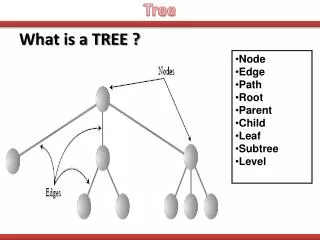
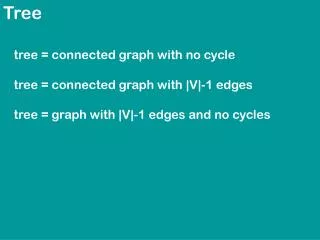
Tree tree = connected graph with no cycle tree = connected graph with |V|-1 edges tree = graph with |V|-1 edges and no cycles
Tree tree = connected graph with no cycle tree = connected graph with |V|-1 edges tree = graph with |V|-1 edges and no cycles no cycle vertex of degree 1 |V|-1 edges vertex of degree 1 connected no vertex of degree 0 (unless |V|=1)
no cycle vertex of degree 1 Supose not, i.e., all vertices of degree 2, yet no cycle. Let v1,...,vt be the longest path vt has 2-neighbors, one different from vt-1. Why cannot take v1,...,vt,u ? Cycle. Contradiction.
|V|-1 edges vertex of degree 1 Suppose all degrees 2. Then |E|=(1/2) deg(v) |V| Contradiction. Done. vV
connected no vertex of degree 0 (unless |V|=1)
Tree connected graph with no cycle connected graph with |V|-1 edges graph with |V|-1 edges and no cycles no cycle vertex of degree 1 |V|-1 edges vertex of degree 1 connected no vertex of degree 0 (unless |V|=1)
connected graph with no cycle connected graph with |V|-1 edges Induction on |V|. Base case |V|=1. Let G be connected with no cycles. Then G has vertex v of degree 1. Let G’ = G – v. Then G’ is connected and has no cycle. By IH G’ has |V|-2 edges and hence G has |V|-1 edges.
connected graph with no cycle connected graph with |V|-1 edges Induction on |V|. Base case |V|=1. Let G be connected |V|-1 edges. Then G has vertex v of degree 1. Let G’ = G – v. Then G’ is connected and has |V’|-1 edges. By IH G’ has no cycle. Hence G has no cycle.
connected graph with no cycle connected graph with |V|-1 edges graph with |V|-1 edges and no cycles Assume |V|-1 edges and no cycles. Let |G1|,...,|Gk| be the connected components. Then |E_i| = |V_i| - 1, hence |E| = |V| - k. Thus k = 1.
Spanning trees How many spanning trees ?
Spanning trees How many spanning trees ? 4
Spanning trees How many spanning trees ?
Spanning trees How many spanning trees ? 8
Minimum weight spanning trees 4 3 2 3 5 7 1 4 6 6 2
Minimum weight spanning trees 4 3 2 3 5 7 1 4 6 6 2
Minimum weight spanning trees 4 3 2 3 5 7 1 4 6 6 2
Minimum weight spanning trees 4 3 2 3 5 7 1 4 6 6 2
Minimum weight spanning trees 4 3 2 3 5 7 1 4 6 6 2
Minimum weight spanning trees 4 3 2 3 5 7 1 4 6 6 2
Minimum weight spanning trees • Kruskal’s algorithm • sort the edges by weight • add edges in order • if they do not create cycle
Kruskal’s algorithm 1) sort the edges by weight 2) add edges in order if they do not create cycle K = MST output by Kruskal T = optimal MST Is K = T ?
Kruskal’s algorithm 1) sort the edges by weight 2) add edges in order if they do not create cycle K = MST output by Kruskal T = optimal MST Is K = T ? no – e.g. if all edge-weights are the same many optima
Kruskal’s algorithm 1) sort the edges by weight 2) add edges in order if they do not create cycle K = MST output by Kruskal T = optimal MST Assume all edge weights are different. Then K=T. (In particular, unique optimum)
Kruskal’s algorithm 1) sort the edges by weight 2) add edges in order if they do not create cycle K = MST output by Kruskal T = optimal MST G connected, e in a cycle G-e connected
Kruskal’s algorithm K = MST output by Kruskal T = optimal MST G connected, e in a cycle G-e connected e the edge of the smallest weight in K-T. Consider T+e.
Kruskal’s algorithm e the edge of the smallest weight in K-T. Consider T+e. Case 1: all edgeweights in C smaller that we Case 2: one edgeweight in C larger that we
Kruskal’s algorithm • sort the edges by weight • add edges in order • if they do not create cycle Need to maintain components. Find-Set(u) Union(u,v)
Union-Find S[1..n] for i 1 to n do S[i] i Find-Set(u) return S[u] Union(u,v) a S[u] for i 1 to n do if S[i]=a then S[i] S[v]
Union-Find S[1..n] for i 1 to n do S[i] i Find-Set(u) return S[u] Union(u,v) a S[u] for i 1 to n do if S[i]=a then S[i] S[v] O(1) O(n)
Kruskal’s algorithm O(1) Find-Set(u) Union(u,v) O(n) • Kruskal’s algorithm • sort the edges by weight • add edges in order • if they do not create cycle
Kruskal’s algorithm O(1) Find-Set(u) Union(u,v) O(n) O(E log E + V^2) • Kruskal’s algorithm • sort the edges by weight • add edges in order • if they do not create cycle
Union-Find 2 S[1..n] for i 1 to n do S[i] i n=|V| Find-Set(u) while (S[u] u) do u S[u] S[u] Union(u,v) S[Find-Set(u)] Find-Set(v) v u
Union-Find 2 S[1..n] for i 1 to n do S[i] i n=|V| Find-Set(u) while (S[u] u) do u S[u] S[u] Union(u,v) S[Find-Set(u)] Find-Set(v) v u
Union-Find 2 S[1..n] for i 1 to n do S[i] i n=|V| Find-Set(u) while (S[u] u) do u S[u] S[u] Union(u,v) S[Find-Set(u)] Find-Set(v) O(n) O(n)
Union-Find 2 S[1..n] for i 1 to n do S[i] i n=|V| Find-Set(u) while (S[u] u) do u S[u] S[u] Union(u,v)u Find-Set(u); v Find-Set(v); if D[u]<D[v] then S[u] v if D[u]>D[v] then S[v] u if D[u]=D[v] then S[u] v; D[v]++ O(log n) O(log n)
Kruskal’s algorithm O(log n) Find-Set(u) Union(u,v) O(log n) • Kruskal’s algorithm • sort the edges by weight • add edges in order • if they do not create cycle
Kruskal’s algorithm O(log n) Find-Set(u) Union(u,v) O(log n) O(E log E + (E+V)log V) • Kruskal’s algorithm • sort the edges by weight • add edges in order • if they do not create cycle
Kruskal’s algorithm log E log V2 = 2 log V = O(log V) O((E+V) log V) O(E log E + (E+V)log V) • Kruskal’s algorithm • sort the edges by weight • add edges in order • if they do not create cycle
Minimum weight spanning trees 4 3 2 3 5 7 1 4 6 6 2
Minimum weight spanning trees 4 3 2 3 5 7 1 4 6 6 2
Minimum weight spanning trees 4 3 2 3 5 7 1 4 6 6 2
Minimum weight spanning trees 4 3 2 3 5 7 1 4 6 6 2
Minimum weight spanning trees 4 3 2 3 5 7 1 4 6 6 2
Minimum weight spanning trees 4 3 2 3 5 7 1 4 6 6 2
Minimum weight spanning trees Prim’s algorithm 1) S {1} 2) add the cheapest edge {u,v} such that uS and vSC S S{v} (until S=V)
Minimum weight spanning trees 1) S {1} 2) add the cheapest edge {u,v} such that uS and vSC S S{v} (until S=V) P = MST output by Prim T = optimal MST Is P = T ? assume all the edgeweights different
Minimum weight spanning trees P = MST output by Prim T = optimal MST P = T assuming all the edgeweights different v1,v2,...,vn order added to S by Prim smallest i such that an edge e E connecting S={v1,...,vi} to SC different in T than in Prim (f)