Download
1 / 15
150 likes | 293 Views
This workshop, led by Natalie Fey at Southampton on September 17, 2004, focuses on developing a Ligand Knowledge Base (LKB) by combining database mining and computational chemistry. The aim is to collect and interpret information on ligands and their transition metal (TM) complexes, leveraging data from structural databases like CSD while utilizing e-science resources. Key topics include the calculation of structural and electronic parameters using DFT, identifying unusual geometries, and exploiting statistical methods for trend prediction. Participants will gain insights into how complementary approaches can enhance structural chemistry databases.

E N D
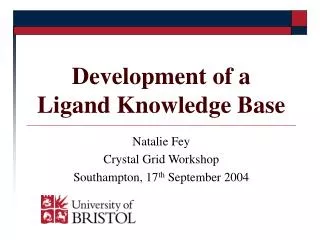
Development of a Ligand Knowledge Base Natalie Fey Crystal Grid Workshop Southampton, 17th September 2004
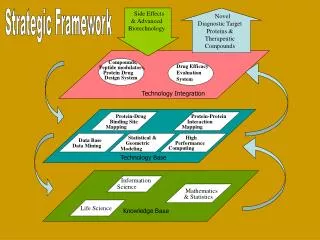
Overview • Ligand Knowledge Base • Synergy of Database Mining and Computational Chemistry: • Part 1: How computational chemistry can add value to database mining results. • Part 2: How database mining can inform a ligand knowledge base of calculated descriptors.
Ligand Knowledge Base • Aims: • Collect information about ligands and their (TM) complexes: • Database mining. • Computational chemistry • Exploit networked computing and data storage resources – e-Science. • Use data: • Interpretation of observations. • Predictions for new ligands.
Computational Chemistry (e.g. DFT) Calculate structural and electronic parameters for known and unknown TM complexes Mine Structural Databases (e.g. CSD) Compile systematic structural information about TM complexes Ligand Knowledge Base Ligand Knowledge Base
Query CSD for structural pattern Main Geometry / Trends Outliers Optimised Geometries Crystal Structure and DFT agree Crystal Structure and DFT disagree Part 1: “Unusual” Geometries Automatic statistical analysis of results apply outlier criteria DFT geometry optimisation compare with crystal structures
Part 1: “Unusual” Geometries Crystal Structure and DFT agree Value Added Why outlier? Structure Report Comment about structure? Yes No Flag for detailed investigation Note in database, may confirm by DFT Further calculations Additional results, add to database
Part 1: “Unusual” Geometries Crystal Structure and DFT disagree Value Added Why? Structure Report Comment about structure? Problem with Calculation Yes No Revised Calculations Problem with Structure Crystal Structure and DFT agree Further calculations Crystal Structure and DFT disagree Flag for detailed investigation Additional results, add to database Note in database
Example – 4-coordinate Ruthenium • Main geometry: tetrahedral (14 structures) • 2 square-planar cases: YIMLEL, QOZMEX • YIMLEL: cis-[RuCl2(2,6-(CH3)2C6H3NC)2]
DFT result: Use as CSD query, any TM… SIVGAV – Pd Supported by structural arguments: short Ru(II)-Cl, Ru-CNR. correct range and geometry for Pd. Run DFT with Pd: 4-coordinate Ruthenium
Part 2: P-donor LKB • Range of DFT-calculated descriptors for monodentate P(III) ligands and TM complexes. • Capture steric and /-electronic properties. • Identification of suitable statistical analysis approaches: • Interpretation. • Prediction.
Part 2: P-donor LKB • Role of database mining: • Stage 1: Database generation. • Inform input geometries (conformational freedom). • Verification of chosen theoretical approach. • Stage 2: Database utilisation. • Supply experimental data for regression models. • Confirmation of calculated trends.
Stage 1 Conformers: e.g. P(o-tolyl)3 Method verification: Examples
Examples • Stage 2: Solid State Rh-P Distance (Rh(I), CN=4)
Conclusions • Synergy of approaches allows to add value to structural databases. • Computational chemistry can be used to verify solid state geometries. • Can exploit e-Science resources to add value on a large scale. • Utility of large databases for structural chemistry of transition metal complexes. • Computational requirements. • Statistical analysis.
Acknowledgements • Guy Orpen, Jeremy Harvey • Athanassios Tsipis, Stephanie Harris • Ralph Mansson (Southampton) • Funding: