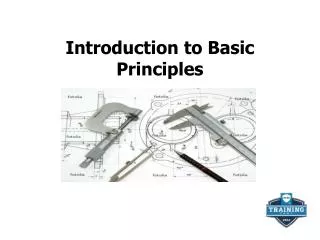
Introduction to Basic Principles
This overview introduces the fundamental principles and various types of level measurement instruments used across industries. It covers traditional methods such as sticks and sounding tapes, mechanical floats, and modern techniques like capacitance, hydrostatic pressure, radar, and sonar. We delve into their applications, working principles, and typical sensors, including important calculations for pressure, volume, and calibration. Additionally, we explore the 4-20mA signal standard, its benefits for long-distance transmission with minimal signal loss, and essential filtration techniques, including coalescing filters and desiccant dryers for air purity.

Introduction to Basic Principles
E N D
Presentation Transcript
Types of Level Measurement • A STICK/SOUNDING TAPE/SITE GLASS • MECHANICAL FLOATS • CAPACITANCE • HYDROSTATIC PRESSURE • RADAR/SONAR
Hydrostatic Pressure • PRESSURE-FORCE/AREA • Water Column • Density and Specific Gravity • P=h*SG/27.68 • Sensor Ranging
Pressure is a function of height Volume is a function of shape
Scale Calculations Dimensions Calibrations Sounding Chart Application nData Sheet
4-20mA Basics • Can be run long distances with minimal loss ~1,000 ft+ • Varying impedance or supply voltage will not affect the signal. • Low electromagnetic susceptibility • Only requires 2 wires to operate
KING Filters • Single stage or dual stage • Main Line or Point of use • Polisher Selection • Scrubber Selection
Coalescing Filtration • Compressed air enters • Travels through filter media • Oil and water attach to fibers • Grow into droplets and fall off into bowl • Replace elements yearly or as needed
King’s Outside to Inside Flow • More surface area for particulate • Nozzle shaped outlet for better discharge
Removing Oil/Water Vapor • Using desiccants to remove vapor through adsorption
Desiccant Dryers • Compressed air passes through an adsorbent media (desiccant) such as activated charcoal, silica gel, or molecular sieve.