Environmental Economics
320 likes | 481 Views
This document explores the field of Environmental Economics, highlighting key issues such as population growth, fossil fuel consumption, acid rain, and ozone depletion. It discusses how these factors impact environmental resources and examines historical responses to air pollution, including the success of the U.S. SO2 cap-and-trade system. The document also addresses current trends in pollutants like CO2 and SO2, and the implications of these changes on global warming and environmental policy. Efforts like the Montreal Protocol are noted in the context of ozone layer protection.


Environmental Economics
E N D
Presentation Transcript
Environmental Economics Hendrik Wolff hgwolff@u.washington.edu
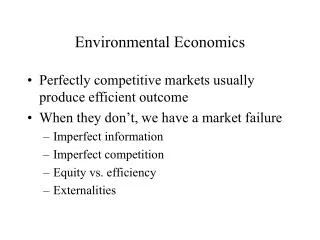
What is EE? • Brief Outline of “some” Environmental Problems • Population Growth • Fossil Fuel burning and Carbon Dioxide • Acid Rain and Sulfur Dioxide • Stratospheric Ozone Depletion
State of the Environment • Population Growth puts pressure on environmental resources
2012: atmospheric • CO2 = 394ppm • http://www.350.org/
Average Daily Temperature Distribution RED: 2090-2100 Projected A2 scenario from CCSM 3.0 in IPCC (2007) BLUE: 1960-90 Normals San Francisco
Average Daily Temperature Distribution Boston Houston RED: 2090-2100 Projected A2 scenario from CCSM 3.0 in IPCC (2007) BLUE: 1960-90 Normals San Francisco
County Temperature Data • Drawback: • 1 day of 115 F & 4 days of 65 F 50 CDD • 5 days of 75 F 50 CDD
33% Decrease 116% Increase
Differential trends in Carbon Dioxide (CO2) versus Sulfur Dioxide (SO2)
Differential trends in Carbon Dioxide (CO2) versus Sulfur Dioxide (SO2)
SO2: First Big “Success” Story of Impact of “Environmental Economics” on Policy • SO2 Acid Rain Dying forests
Cap and Trade of SO2 emissions • By late eighties: U.S. emits 20 million tons SO2/year • 1990 C & T established with goal to cut emissions by 50% over 10 years
Cap and Trade of SO2 emissions • By late eighties: U.S. emits 20 million tons SO2/year • 1990 C & T established with goal to cut emissions by 50% over 10 years • Figure of “price of sulfur” = marginal abatement cost of SO2 control dropped from USD 500 to USD65
Ozone Depletion in Stratosphere • Ozone in Stratosphere necessary to decrease ultra violet radiation to hit planet (UV-Bskin cancer) • Refrigerants (i.e. CFCs) destroy O3 molecules • World observes steady magnitude of ozone hole in stratosphere since 1980 • 1986: Montreal Protocol bans (most) CFCs • Ozone hole slowly starting now to decrease BUT global warming cools stratosphere, difficult to predict... • http://www.youtube.com/watch?v=qUfVMogIdr8
Ozone Depletion in Stratosphere • Ozone in Stratosphere necessary to decrease ultra violet radiation to hit planet (UV-Bskin cancer) • Refrigerants (i.e. CFCs) destroy O3 molecules • World observes steady magnitude of ozone hole in stratosphere since 1980 • 1986: Montreal Protocol bans (most) CFCs • Ozone hole slowly starting now to decrease BUT global warming cools stratosphere, difficult to predict... • http://www.youtube.com/watch?v=qUfVMogIdr8
Which Pollutants Increase/Decrease? • Increase • CO2 • Illegal oceanic waste dumping • Nuclear contamination • Particulate Matter in Urban Areas (Developing Countries) • Decrease • SO2 in U.S. • Local Water Pollution Homework
Which Pollutants Increase/Decrease? • Increase • CO2 • Illegal oceanic waste dumping • Nuclear contamination • Particulate Matter in Urban Areas (Developing Countries) • Decrease • SO2 in U.S. • CFCs worldwide • Local Water Pollution Homework
Which Pollutants Increase/Decrease? • Increase • CO2 • Illegal oceanic waste dumping • Nuclear contamination • Particulate Matter in Urban Areas (Developing Countries) • Decrease • SO2 in U.S. • CFCs worldwide • Local Water Pollution Homework