Strategies for Channel Assignment in PCS: Hand-Off and Initial Access Analysis
240 likes | 347 Views
This paper presents an in-depth analysis of channel assignment strategies for Personal Communication Services (PCS) during hand-off and initial access scenarios. It discusses various analytic models, such as Non-Prioritized Scheme (NPS), First In First Out (FIFO), and Measured-Based Priority Scheme (MBPS), evaluating their performance through simulation. The findings indicate that MBPS yields lower blocking probabilities compared to FIFO and NPS, highlighting the sensitivity of performance metrics to mobility and traffic load. The study aims to enhance channel assignment efficiency in mobile communication systems.


Strategies for Channel Assignment in PCS: Hand-Off and Initial Access Analysis
E N D
Presentation Transcript
QueueingPriority Channel Assignment Strategies for PCS Hand-Off and Initial Access IEEE TRANSACTIONS ON VEHICULAR TECHNOLOGY,1994 Yi-Bing Lin, Seshadri Mohan, and Anthony Noerpel Speaker: R01922021 趙祈鈞
Outline • Introduction • Related Works • Analytic Models • Traffic Model • System Model • Simulation • Conclusions
Introduction • Personal Communication Service(PCS) • Cells and channels • Provides wireless access to PSTN • Hand-off, or Automatic Link Transfer(ALT) • PCS radio systems • DECT, CT-2 Plus (with signaling channel) • WACS (directly on traffic channel)
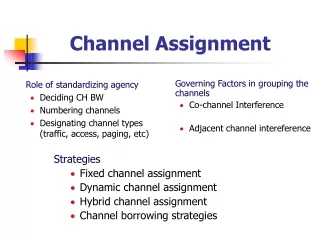
Introduction • ALT strategies • Portable-controlled • DECT, WACS • Network-controlled • CT-2 Plus • Portable-assisted • ALT-initial access channel assignment schemes • Non-prioritized scheme (NPS) and Guard channel
Introduction • ALT-initial access channel assignment schemes • FIFO //degradation interval • Measured-based priority scheme (MBPS) • FIFO scheme with different queueing policy
Related Works • Hong and Rappaport [10] //FIFO • Based on a special portable movement pattern by Poisson process • Tekinary and Jabbari [17] //FIFO • Td normally distributed, Markov chain • [9] says expo. dist. is more suitable for Markov chain • Considered the hand-off traffic as an indep. input (X) • Yoon and Kwan [19] • hand-off traffic as an indep. input (X) • M/M/C/K instead of timeout system • This paper • NPS, FIFO and MBPS, 50/10 servers per cell
Analytic Models (Traffic) • A portable moves across K cell boundaries • Also # of hand-offs • Call holding time: tc (expo.) density: • Start at R0, visits K cells, tM_i: time in i-th cell • Time of R0 to 1: tm, density: • tMi is i.i.d., dist.: density: mean:
TrafficModel • By Random Observer Property(ROP) of Poisson • For K>=1,
Traffic Model • Use (1) and (2), • with Laplace transform
Traffic Model • Let be an exponential distribution • M/G/c => M/M/c ,so • Hand-off call arrival rate
Traffic Model • Pc: prob{call completed} • If • If • Obs. of Hong and Rappaport [10] not general • Pnc is more sensitive to Po than to Pf (X) • From (10), ↑
Analytic Models(system) • For NPS, • For FIFO • t_d: expo. • Mean:
System Model for nps • t_co = min(t_c, t_m) //t_channel occupancy = min(t_call holding, t_remaining portable residual)
System Model for nps • From the Erlang-B formula • For lost systems (no queue) • Total traffic load • Avg. arrival rate • Avg. service rate • NPS:
System Model for fifo • FIFO • t_q = min(t_d, t_m) //t_maxqueueing = min(t_timeout, t_remaining portable residual) • A hand-off call is blocked if no channel is assigned before t_maxqueueing • density:
System Model for fifo • State s(n), n>=0 • n: # of busy channels • For 0<=n<c • S(n) has n busy channels, no HO in queue • For n=c+j>=c • All c channels busy, j HOs in queue, new calls dropped
System Model for fifo • Steady state probability for s(n)
System Model for fifo • Prob{originating call blocked} • Prob{hand-off call blocked} • Let a hand-off call Ct arrives at t in state s(n) • //n=c+j, so Ct will be in queue • Suppose the 1st call leaves the queue at t+tj • Ct needs to wait for j+1 calls before him.
System Model for fifo • E[waiting time]
Simulation • Discrete event simulation model • 1st chooses a • Simulates to obtain Po and Pf • Use (9) to compute new lambda_h • Repeat until lambda_h converges • 3 types of events • ARRIVAL • originating or hand-off • COMPLETION • Calls releasing channels (completes or portable moves) • WAIT
Simulation • Sim_count: N • Record No, Nf • Initial, gen 1st • Max N: 800,000 • ARRIVAL • o or h: rand() • (13) Iter. ends • (10) e1:timeout(11)
analysis vs. Simulation • Plot Pf, Po, Pnc and normalized E[waiting] • c=50, 1/miu=3min, 1/gamma=18s, 1/eta=30min • Compare with [17] • Pf and Po for MBPS always < that for FIFO (X)
Simulation • NPS vs. FIFO • c=10, 1/miu=3min 1/eta=10min 1/gamma=18s, 55s • (c): Pr[f|nc] • FIFO • Better w/ small gamma • Pf↓ Pnc little↓ • because Po little↑
Conclusions • Proposed analytic and simulation models to study ALT-initial access channel assignment schemes(NPS, FIFO, MBPS). • Major output measures: Po, Pf, Pnc • Vs. Hong and Rappaport [10] • Pnc is more sensitive to Po than to Pf (X general) • Indicated if mobility↑, impact of Pf on Pnc↑, of Po↓ • Vs. Tekinary and Jabbari [17] • MBPS provides lower Pf and Po (X) • Indicate that MBSP and FIFO roughly the same(Pf, Po) • FIFO significantly Pf↓, slightly Po↑ • Yield slightly better (smaller) Pnc //vs. NPS