Download
1 / 7
70 likes | 195 Views
This research presentation addresses the challenges faced by young individuals in Victoria transitioning from Out-of-Home Care (OHC) to prevent their overrepresentation in the Youth Justice system. By identifying key practices and interagency collaborations among child protection and youth justice, the study aims to promote effective leaving care plans and post-care support services. It explores the demographic backgrounds and risk trajectories of dual clients, highlighting the necessity of addressing trauma, improving interagency protocols, and providing adequate support to enhance their integration into society.

E N D
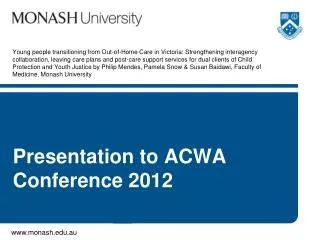
Young people transitioning from Out-of-Home Care in Victoria: Strengthening interagency collaboration, leaving care plans and post-care support services for dual clients of Child Protection and Youth Justice by Philip Mendes, Pamela Snow & Susan Baidawi, Faculty of Medicine, Monash University Presentation to ACWA Conference 2012
Aim of Research: To identify practices and policies that will reduce the over-representation of young people Leaving Out-of-Home Care (OHC) through entry into the Youth Justice system, and promote their inclusion in mainstream social and economic life.
Rationale for Research: care leavers ad disadvantaged group who are over-represented in criminal justice system. This has negative health and socio-economic implications. Number of factors which contribute to this over-representation such as child abuse and neglect, gender, time of entry into care, residential care, and unsupported transitions from care.
Key objectives of study: • 1) Why are they over-represented? • 2) Inter-agency collaboration between child protection and youth justice. • 3) What are their demographic backgrounds and risk trajectories? • 4) Identify social and educational preventive programs.
Methodology: partnership with seven child and youth welfare agencies in Victoria; • Qualitative exploratory design exploring perspectives of key workers and young people involved in both systems. 77 workers involved in consultations to date.
Key findings: • 1) Unaddressed trauma and attachment issues arising from child abuse and neglect; • 2) Variable level of inter-agency collaboration reflecting lack of protocols; • 3) Youth Justice system not able to address complex issues. • 4) Poor leaving care supports including lack of housing contributes to involvement in offending.
Further research: • More systematic data collection on profiles and history of dual order young people • Inter-agency collaboration in the residential care context.