Download
1 / 3
30 likes | 164 Views
This article explores the outdated nomenclature used for transition metals, where suffixes replaced Roman numerals to indicate oxidation states. Originally used by older chemistry textbooks, this method, while not specific enough, remains present in some educational contexts. The suffixes –ic and –ous denote higher and lower charges, respectively. Examples include Iron (III) as Ferric, Iron (II) as Ferrous, and Copper (II) as Cupric. This historical naming system, though largely supplanted, provides insight into the development of chemical nomenclature.

E N D
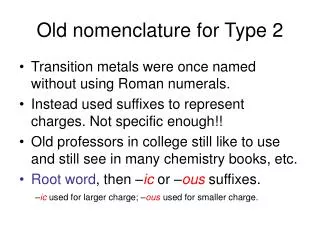
Old nomenclature for Type 2 • Transition metals were once named without using Roman numerals. • Instead used suffixes to represent charges. Not specific enough!! • Old professors in college still like to use and still see in many chemistry books, etc. • Root word, then –ic or –ous suffixes. –icused for larger charge; –ousused for smaller charge.
Fe3+ Iron (III) Fe2+ Iron (II) Cu2+ Copper (II) Cu+ Copper (I) Sn4+ Tin (IV) Sn2+ Tin (II) Hg2+ Mercury (II) Hg2+ Mercury (I) Pb4+ Lead (IV) Pb2+ Lead (II) Ferric Ferrous Cupric Cuprous Stannic Stannous Mercuric Mercurous Plumbic Plumbous
Co3+ Cobalt (III) Cobaltic • Co2+ Cobalt (II) Cobaltous • Cr3+ Chromium (III) Chromic • Cr2+ Chromium (II) Chromous • Mn3+ Manganese (III) Manganic • Mn2+ Manganese (II) Manganous • Au3+ Gold (III) Auric • Au2+ Gold (II) Aurous