Download
1 / 9
90 likes | 202 Views
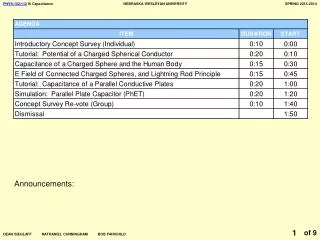
This announcement covers three key concepts in electrostatics involving conductive spheres and parallel plate capacitors. First, it discusses how the electric potential varies between two conductive spheres with positive charge, emphasizing the impact of their sizes on potential differences. Secondly, it analyzes the electric fields when the spheres are connected by a wire and possess excess charge. Lastly, it looks at parallel plate capacitors connected to a 1.5V battery, evaluating the relationship between plate separation and charge. These topics are crucial for understanding electrostatic principles.

E N D
1 of 3 • Conductive spheres A and B both have positive charge Q which is uniformly distributed on the surface (the spheres are very far apart). Sphere A has greater radius than sphere B. The potential of B is • Greater than that for A. • Equal to that for A. • Less than that for A. Q + Q + + + + A + B + + + + + + + + + + 2
2 of 3 • Conductive spheres A and B are connected by a fine wire. B is smaller than A. The system possesses excess charge. The electric field at the surface of B is • Greater than that for A. • Equal to that for A. • Less than that for A. + + + + A B + + + + + + + + 3
3 of 3 • Parallel plate capacitors A and B are connected to a 1.5 V battery, and have plate area A. Capacitor A has plate separation d. Capacitor B has plate separation 2 d. The magnitude of charge on each plate of B is • Zero. • half that of A. • equal to that of A. • twice that of A. B A 2d d A A 1.5V 4
1 of 3 • Conductive spheres A and B both have positive charge Q which is uniformly distributed on the surface (the spheres are very far apart). Sphere A has greater radius than sphere B. The potential of B is • Greater than that for A. • Equal to that for A. • Less than that for A. Q + Q + + + + A + B + + + + + + + + + + 6
2 of 3 • Conductive spheres A and B are connected by a fine wire. B is smaller than A. The system possesses excess charge. The electric field at the surface of B is • Greater than that for A. • Equal to that for A. • Less than that for A. + + + + A B + + + + + + + + 7
3 of 3 • Parallel plate capacitors A and B are connected to a 1.5 V battery, and have plate area A. Capacitor A has plate separation d. Capacitor B has plate separation 2 d. The magnitude of charge on each plate of B is • Zero. • half that of A. • equal to that of A. • twice that of A. B A 2d d A A 1.5V 8
PROJECTION SCREEN 1 4 1 4 1 4 1 4 2 5 2 5 2 5 2 5 3 6 3 6 3 6 3 6 HAND IN TODAY’S ACTIVITIES SHEETS 9