Understanding Biogeochemical Cycles: Essential Processes for Life on Earth
All organisms require water, minerals, and other life-sustaining materials to survive. Key biogeochemical cycles such as the hydrologic, carbon, nitrogen, and phosphorus cycles facilitate the transfer of essential nutrients and elements within the biosphere. The hydrologic cycle involves condensation, precipitation, infiltration, runoff, and evaporation. The carbon cycle emphasizes carbon's role in living organisms, while the nitrogen cycle includes processes such as nitrogen fixation, ammonification, nitrification, assimilation, and denitrification. The phosphorus cycle, however, has no atmospheric component. Understanding these cycles is crucial for comprehending ecosystem dynamics.

Understanding Biogeochemical Cycles: Essential Processes for Life on Earth
E N D
Presentation Transcript
Cycles • All organisms need water, minerals, and other life-sustaining materials to survive. Ex. Hydrologic – necessary for all life Ex. Carbon – backbone of organic compounds (carbs, lipids, proteins) Ex. Phosphorus – uprights of DNA ladder Ex. Nitrogen – needed to make amino acids • Elements, chemical compounds, other forms of matter are passed from one org to another and from one part of the biosphere to another through BIOGEOCHEMICAL CYCLES.
The hydrologic cycle PerryCondensation, Precipitation, Infiltration, Runoff, Evaporation
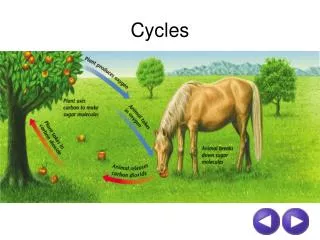
Carbon Cycle— Perry Carbon is the KEY ingredient in ALL living things Volcano Decomposition Fossil Fuels
Nitrogen Cycle— PerryNitrogen is abundant in the atmosphere, but must be ‘fixed’ to get in to living systems – ONLY a certain type of bacteria can do this!!!
5 terms to be sure of… • Nitrogen fixation: The incorporation of atmospheric nitrogen by either free-living bacteria in the soil or by bacteria living mutualistically with plant roots. • Ammonification: the conversion of organic nitrogen to ammonium (NH4+) by the action of decomposers (ex. fungi, bacteria). • Nitrification: The chemical process in which a nitrogen group is added to an organic compound. This converts dead organic material into nitrates and nitrites by soil bacteria. Autotrophs use nitrates and nitrites for nutrient needs. • Assimilation: the addition of material to autotrophs for use in matter recycling and flow of energy • Denitrification: the return of nitrogen to the atmosphere by bacteria (convert to gaseous form)