Download
1 / 30
300 likes | 435 Views
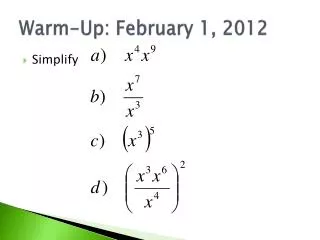
Simplify 3 x 10 4 ∙ 5 x 10 5 15 x 10 9 b) 1.5 x 10 10 c) 15 x 10 20. Real life examples of Exponential Growth. Projected. World Population 6,896,822,169 18:22 UTC (EST+5) Jan 30, 2011 . Actual. 8.5 and 8.6: Exponential Growth and Decay y = ab x.

E N D
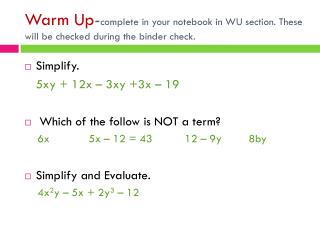
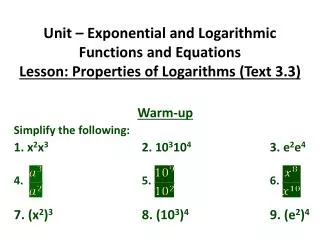
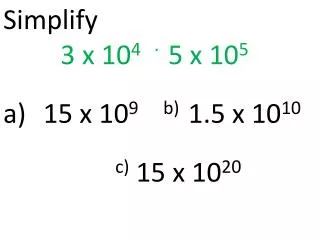
Simplify • 3 x 10⁴ ∙ 5 x 10⁵ • 15 x 109 b) 1.5 x 10¹⁰ • c) 15 x 1020
Projected World Population 6,896,822,16918:22 UTC (EST+5) Jan 30, 2011 Actual
8.5 and 8.6: Exponential Growth and Decayy = abx Linear Exponential Growth Exponential Decay
Exponential Growth Exponential Decay y = a ( 1 + r ) t y = a ( 1 - r ) t a = t = r = (always change r to a ____________)
Mr. Luttrell’s first car purchased was a used 2000 Chevy Cavalier. Brand new, the car cost $14,500. The car depreciates in value by 15% per year. How much did Mr. Luttrell pay for his car in 2004? $14,500 y = a ( 1 - r ) t a= r= t=
Identify which situation represents exponential growth: Jim earns $5 for each A on his report card. The population of California increases at a rate of 5.6% per year. A house’s value depreciates at a rate of 3% per year.
Identify which situation represents exponential decay: Jim’s pay doubles every year. Barbara tips 18% at a restaurant. Annie’s boat’s value depreciates at a rate of 20% per year.
The value of Ed’s house depreciates (loses value) at a rate of .5% per year. If he bought the house for $180,000 , what is the value of his house after 30 years? a.) y = 180,000( 1 + .5)30 b.) y = 180,000( 1 - .005)30 c.) y = 180,000( 1 - .5)30
College isn’t cheap…. At Otterbein University, the current tuition is $36,300 for tuition and room and board for one year. If the costs of tuition increases every year by 3%, what will be the cost when you start college in 5 years? ….. Start saving now! a.) y = 36,300(1+.03)5 a)$41,734!!!! b.) y = 36,300(1 - .03)5 c.) y = 36,300(1 + 3)5
Evaluate when x = -2 and y = -3 x2 y3 x
Y = 2000 (1 + .055)5 b.) y = 18,000(1 + .055)5 c.) y = 2000(1 + 5.5)5 d.) y = 18,000(1 + 5.5)5
Exponential Growth Exponential Decay Linear
Y = 200 (.5)x Exponential Growth Exponential Decay Linear
Y = 3x Exponential Growth Exponential Decay Linear
Y = 2x + 8 Exponential Growth Exponential Decay Linear
George put $500 in the bank at 3% interest for 8 years. How much money did he have at the end of the 8 years if he made no deposits or withdraws? a) $32768000 $633.39 $391.87