
Insert Presentation Title Here
E N D
Presentation Transcript
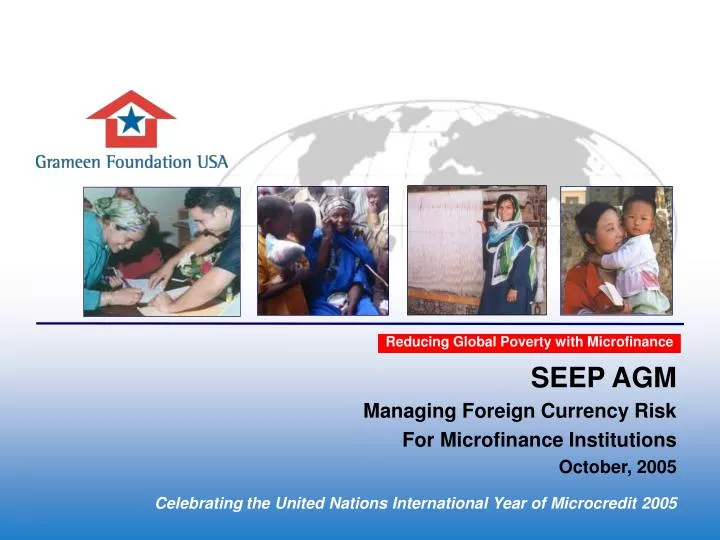
Reducing Global Poverty with Microfinance SEEP AGM Managing Foreign Currency Risk For Microfinance Institutions October, 2005 Insert Presentation Title Here Celebratingthe United Nations International Year of Microcredit 2005
$$$: Capital in Microfinance The Issue: $1.2 Bn, but mostly the “wrong” type of capital & and lots more new private investment coming up % of Supply MF Invest Supply ~ $1.2B Private 25% Africa 6% Local 8% Debt 69% Asia 12% Public 75% Hard / Foreign 92% Latin Am 41% E. Eur./ x-USSR 46% Equity, Guar. 31% Capital Type Source Region Currency (For Debt) Source: CGAP Opportunity: Foster private, local currency esp. to Asia & Africa
Foreign Currency Issues for MFIs Risk is acute: 23 countries, avg. 8.8% compounded ann. decline of local currency against US$. In 22, currency down 3+ years.(WWB White Paper) • Hard currency financing: who should carry the risk? • MFIs are arguably in the worst position to bear foreign currency risk • Hard currency issuances reduce risk to investors. Since many investors are socially motivated, they might be willing to take on more FX risk through local currency transactions • There has been little industry engagement on this issue w/ donors, who at least in terms of mission, are strong stakeholder to address Oversimplified Example: Cost of Debt MFIs think they get cheaper money, but not always the case Which is cheaper: hard currency @ 8% or local currency @ 12%? If devaluation or relative inflation < 4%, hard currency. If devaluation or relative inflation > 4%, local currency. Ex. If devaluation = 12%, total loan cost ~ 20%. Ouch!!
5 Strategies to Address F/X Risk • Pursue Local Currency Options First • Establish Internal Policies on FX Management & Exposure • Convert Hard Currency Loans to Local Currency • Explore FX Hedging Instruments • Others (less ideal) • Match lending to borrowing • Pass through cost to client These 5 strategies, including case studies, are detailed in new SEEP Progress Note No. 13 (co-authored by WWB/GFUSA)
GFUSA Capital Markets Strategy • Develop and manage GFUSA branded financial products • Simple, flexible, with varied risk-return profiles • Establish “Microfinance as an Asset Class” • Identify, negotiate & execute local currency capital markets opportunities • Present microfinance risk-return in terms that investors understand • Demonstrate leadership linking poverty-focused microfinance and the capital markets • Facilitate domestic capital market as the primary source of long-term financing for MFIs while incorporating interested international investors • Spread GFUSA capital markets knowledge to countries with high numbers of poor people Goal: Harness vast resources from the capital markets to support rapid expansion of leading, poverty-focused MFIs
GFUSA Approach to FX - Avoid It First Product: GFUSA Growth Guarantees • Up to $50 million facility, 100% private capital in the form of back-to-back stand by letters of credit (SBLCs). Citibank issues US$ to In-Country Bank. • MFI receives leveraged local currency loans. Local bank carries F/X risk. • GFUSA is actively involved in assisting the MFI with bank negotiations and structuring. Benefits • Increasing access to investment for world-wide poverty-focused MFIs • Get beyond favorite 114 MFIs receiving 70% of investment capital • Flexible regarding MFI legal structure (includes NGOs) • Emphasizes local capital markets • Many local markets have extensive excess liquidity • Local banking relationships ultimately healthier and more sustainable • Support variety of financings: loans, bonds, securitizations, agency model, etc. • MFIs get cheaper pricing & better capital access • Reduce hesitation for local investors and banks to participate in the sector • Seek interest rates closer to prime rate; lengthen tenors
Key Take-Aways • Important for MFIs to consider F/X issues in advance, rather than in crisis. For example, have a policy • Hard currency is tempting, but can you afford it? • May be more expensive at first, but better/cheaper in long run • How much will you really be saving? • F/X must be managed actively • It cannot be removed, but it can be minimized • Potential for declining/flat dollar in the near future reduces attention to this issue • BUT remember currency meltdowns i.e. Mexico, Indonesia, Russia & ripple effects elsewhereALL within the last decade
For Discussion • Add your examples on addressing F/X issues • What can we (SEEP community) do? • Develop a message to donors • Develop a message to private investors • T.A. to MFIs to overcome challenges and to take action • Increase industry’s market-rate investment transactions • Innovations and new ideas Consider market-oriented industry initiatives to address the problem • Create a fund to hedge currencies • Develop an insurance type of product that covers F/X Risk • Work with donors & socially motivated investors in new ways
Thank you! Drew Tulchin Capital Markets Group 202-628-3560 x123 www.gfusa.org


![[Insert your presentation title here.]](https://cdn1.slideserve.com/1999241/slide1-dt.jpg)


![[Insert your presentation title here]](https://cdn2.slideserve.com/3953758/insert-your-presentation-title-here-dt.jpg)








![[Insert Title Here]](https://cdn3.slideserve.com/6833485/insert-title-here-dt.jpg)
![[ Insert Title Here ]](https://cdn4.slideserve.com/8936996/insert-title-here-dt.jpg)