Advancements in Quantum Algorithms and Communication: SP5 Theory Highlights
In the past year, SP5 has achieved over 200 theoretical articles, meeting all deliverables and milestones with no problems reported. This year, a similar trajectory is expected, focusing on algorithms, complexity, and protocol developments for quantum commerce. Key studies include efficient quantum algorithms for hidden subgroup problems and exploring the limits of quantum channels. Significant contributions have also been made in quantum cryptography and entanglement, emphasizing device-independent security. The highlights position SP5 at the forefront of theoretical advances in quantum information.

Advancements in Quantum Algorithms and Communication: SP5 Theory Highlights
E N D
Presentation Transcript
QAP SP5 Theory
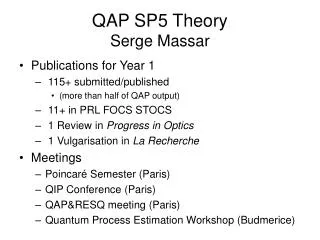
QAP SP5 TheorySerge Massar • Last year: • 200+ theory articles • (almost) All deliverables and milestones met • This year: • No reason to expect a less impressive and important production • No problems reported by WP managers
WorkPackages • WP5.1 Algorithms and Complexity • WP5.2 Algorithmic Methods • WP5.3 Protocols for Quantum Commerce • WP5.4 Toolbox for quantum multi-user protocols • WP5.5 Architectures • WP5.6 Testing Quantum Systems
Quantum Algorithms • G. Ivanyos, L. Sanselme, M. Santha • An efficient quantum algorithm for the hidden subgroup problem in nil-2 groups • An efficient quantum algorithm for the hidden subgroup problem in extraspecial groups
Algorithmic Methods • D. Aharonov, D. Gottesman, J. Kempe • The power of quantum systems on a line • It is possible to perform universal adiabatic quantum computation using a one-dimensional quantum system (with 9 states per particle). • The problem of approximating the ground state energy of a system composed of a line of quantum particles is QMA-complete; QMA is a quantum analogue of NP. • The analogous classical problem, namely, one dimensional MAX-2-SAT with nearest neighbor constraints, is in P). • Since it is unlikely that quantum computers can efficiently solve QMA problems, this construction gives a one-dimensional system which, at low temperatures, takes an exponential time to relax to its thermal equilibrium state. This makes it a candidate for a one-dimensional spin glass.
Quantum Communication • A. Winter • The maximum output p-norm of quantum channels is not multiplicative for any p>2 • Four pages only. If you write to me, please don't tell me how simple and obvious it is - I know that myself. I accept suggestions for journals to submit to, though; the obscurer the better :-) V2 has some corrections, and I removed one reference. Don't miss the more recent work arXiv:0707.3291 • P. Hayden • The maximal p-norm multiplicativity conjecture is false • these counterexamples demonstrate that if the additivity conjecture of quantum information theory is true, it cannot be proved as a consequence of maximal p-norm multiplicativity.
Bell Inequalities • Marek Zukowski, Marcin Wiesniak, Piotr Badziag • All tight multipartite Bell correlation inequalities for three dichotomic observables per observer • Explicit form of correlation function three-settings tight Bell inequalities for three qubits
Quantum Entanglement and Quantum Cryptography • A. Acin, N. Brunner, N. Gisin, S. Massar, S. Pironio, V. Scarani • Device-independent security of quantum cryptography against collective attacks • We present the optimal collective attack on a Quantum Key Distribution (QKD) protocol in the "device-independent" security scenario, where no assumptions are made about the way the QKD devices work or on what quantum system they operate.
New Systems/Methods for experimental QIPC • N. M. VanMeter, P. Lougovski, D. B. Uskov, K. Kieling, J. Eisert, J. P. Dowling • A General Linear-Optical Quantum State Generator • N. Brunner, N. Gisin, V. Scarani, C. Simon • Detection loophole in asymmetric Bell experiments • For the Bell inequality I_3322, a minimal detection efficiency of 43% can be tolerated for one of the particles, if the other one is always detected
Spin-Off: demo of fundamental process: • A. Retzker, J. I. Cirac, M. B. Plenio, B. Reznik • Detection of acceleration radiation in a Bose-Einstein condensate • We study methods for detecting the Unruh effect in a Bose-Einstein condensate. The vacuum of a Bose-Einstein condensate is used to simulate a scalar field-theory, and accelerated atom dots or optical lattices as means for detecting phonon radiation due to acceleration effects.
Quantum State Tomography • K.M.R. Audenaert, J. Calsamiglia, Ll. Masanes, R. Munoz-Tapia, E. Bagan, A. Acin, F. Verstraete • The Quantum Chernoff Bound • P. Rapcan, J. Calsamiglia, R. Munoz-Tapia, E. Bagan and V. Buzek • Recycling of quantum information: Multiple observations of quantum systems
Strategic Questions • Identify the highlights of SP5 • Define new milestones and deliverables • Theory meeting? • 2007: Bristol • Theory meeting in 2008? • What format? • Which organisers?
Thanks to Oded Regev, Toni Acin, Konrad Banaszek, Mario Ziman