Understanding Employment Classifications and Exclusions Under Labor Law
This document outlines key classifications of employees under various statutory and non-statutory frameworks, including the implications of the Government Railway Labor Act, as well as distinctions between independent contractors and different employee categories. It highlights case law that defines employment status, the coverage exclusions for managerial and domestic employees, and the considerations for graduate assistants and disabled workers. This summary serves as a guide for navigating employment law complexities and understanding employee rights and protections within different contexts.

Understanding Employment Classifications and Exclusions Under Labor Law
E N D
Presentation Transcript
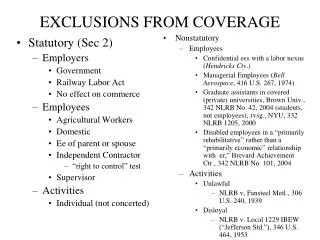
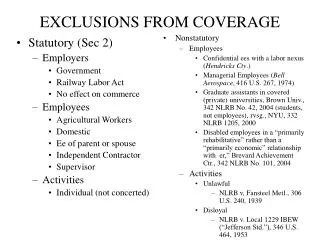
Statutory (Sec 2) Employers Government Railway Labor Act No effect on commerce Employees Agricultural Workers Domestic Ee of parent or spouse Independent Contractor Supervisor Activities Individual (not concerted) Nonstatutory Employees Confidential ees with a labor nexus (Hendricks Cty.) Managerial Employees (Bell Aerospace, 416 U.S. 267, 1974) Graduate assistants in covered (private) universities, Brown Univ., 342 NLRB No. 42, 2004 (students, not employees), rvsg., NYU, 332 NLRB 1205, 2000 Disabled employees in a “primarily rehabilitative” rather than a “primarily economic” relationship with er,” Brevard Achievement Ctr., 342 NLRB No. 101, 2004 Activities Unlawful NLRB v, Fansteel Metl., 306 U.S. 240, 1939 Disloyal NLRB v. Local 1229 IBEW (“Jefferson Std.”), 346 U.S. 464, 1953 EXCLUSIONS FROM COVERAGE