Standard Template Library
160 likes | 289 Views
This homework assignment covers the Standard Template Library (STL) in C++, focusing on its three core components: Containers, Iterators, and Algorithms. Students will explore various container types, such as vectors, lists, and maps, along with their operations and methods. The assignment highlights how iterators allow for efficient navigation through these containers and discusses pre-defined algorithms for manipulating the data held within. Homework must be submitted by November 15. Additional resources and examples can be found online.


Standard Template Library
E N D
Presentation Transcript
Homework • List HW will be posted on webpage • Due Nov 15
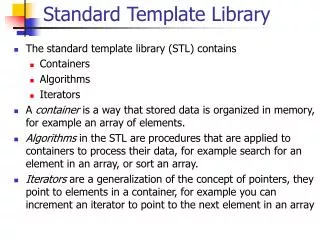
The STL includes: • Containers – a data structure which holds arbitrary data type • Iterators – way of ‘browsing’ through a container • Algorithms – operations which can be performed on any container (where it makes sense)
Containers • vector • list • deque (double-ended queue) • set and multiset • map and multimap
vector • Much like an array • Accessible with [] • Provides constant-time random access • Dynamically resizable • May be of any type.
list • Changes size as elements are inserted or deleted • May be of any type.
list syntax #include <list> using namespace std; void aFunc() { list<float> lst; lst.push_back(7.0); }
Some list methods • Since list is a class, it has methods • push_back() • pop_back() • front() • back() • empty() • clear() • size() • resize() • capacity() • See www.sgi.com/tech/stl/list.html
Iterator • Iterators are a convenient way to ‘browse’ • Every container offers a object.start() • Every container offers an object.end() • Every iterator supports ++ and - - (no matter what the structure of the container)
List organization • From any car in the train you may go to the preceding or succeeding one • Use ++ or - - operation on the iterator
Lists • #include <list> • A list is like a freight train • Cars in sequence, starting with 0 • Each car is a container for a type of data – e.g. an int, a float, a object
Examine the elements of a list #include <list> using namespace std; int main() { list<float> lst; list<float>::iterator lp; for (lp = lst.begin(); lp != lst.end(); ++lp) { // do something here } return 0; }
Algorithms • You must include the header #include <algorithm> using namespace std;
Algorithms • Provides standard algorithms like sort and swap on any kind of data in the container, provided …
Algorithms • Provides standard algorithms like sort and swap on any kind of data in the container, provided … • That prerequisites are defined (the < operator for sort)
Sort algorithm example #include <list> #include <algorithm> #include <iostream> using namespace std; int main() { list<int> lst; for (int i = 0; i < 5; ++i) { int aNum = rand() % 100; lst.push_back(aNum); } lst.sort(); return 0; }