Download
1 / 17
170 likes | 306 Views
This document outlines Duquesne Light Co.'s innovative approach to Electric Management System (EMS) migration utilizing an Integration Bus (UIB). Highlighting the importance of modularity and real-time data access, the strategy integrates collaborating components over a Local Area Network (LAN) with SQL Server for data persistence. Key features include a standard publish-and-subscribe methodology, a single interface for both vendor and in-house applications, and efficient event notification systems. This migration is designed to minimize operator disruption while allowing for future scalability and adaptability in a changing technological landscape.

E N D
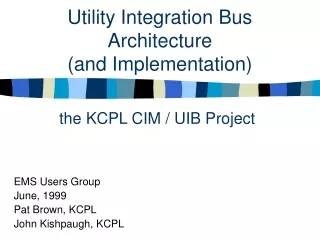
Utility Integration Bus Approach To System Migration Duquesne Light Co.
EMS Migration • Never Done • Choices at every step • Employ standards whenever possible
Duquesne’s EMS Migration • First Cut • MMS as the Integration Bus • SQL Server for Data Persistence
Duquesne’s EMS Migration • Established access to all real-time data using MMS and the GOMSFE Basic RTU Model • Separated EMS Functions into Collaborating Components on a Local Area Network • Using the LAN, MMS, and DCOM and SQL Tables as the Integration Bus
Utility Integration Bus Approach • Need for the standard Bus • Tried DCOM • Tried SQL Update Queue
Utility Integration Bus Approach • Single Interface for All components • 1 to 1 interfaces don’t work • Redundant Data Providers and consumers • Single queue for maintenance, persistence and security
Utility Integration Bus Approach • Publish and Subscribe • Provide single interface for vendor and in-house development • Thin Specification approach • Reduced Documentation
Operator Event Notification • First Step in Migration • Minimize impact on Operators • Single point for Operator notification
Operator Event Notification • New Events Published to the “Event Forwarder” • Operator Screens Subscribe to a category of events • Historian Function Subscribes to all events • Acknowledgment and clearing published to “Event Forwarder”
DCOM Event Publishers Operator Event Screens DCOM Event Historian Event Diagram MTS DCOM Event Forwarder DCOM DCOM
SCADA Function • Field Data Changes Published to SQL Database and SQL “Queue Table” • Operator One Lines Subscribe to Database for changes • Change detection and Limit Detection subscribe to “Queue Table” • On Change Detection Message Published to Event Notification System
Operator SCADA Screens SCADA Diagram SQL Database Real-Time Data Base Change Queue UCA Publishers Status Change Publisher DCOM UCA Devices ( MMS Servers) Event System
Need a Common Publish and Subscribe Bus(UIB) • Event Actions and SCADA Data Published to the Same Bus • Onelines and Operator Event Screens Subscribe to the Same Bus • Messages differentiated for quick routing • Security Redundancy and a Persistent Queue needed
Event Publishers UCA Publishers Operator Event Screens Operator SCADA Screens UIB Diagram Real-Time Data Base Event Historian UIB
Utility Involvement • Get involved in EPRI’s CCAPI • CIM is the Data Model • Bus is needed to integrate different Applications. • Standard Message Types, Security Roles and Redundancy Schemes
UIB Immediate Benefits • Plug and Play applications • Integration of NERC-Tagging, Oasis, ISN, IIDC • Pennsylvania Customer Choice applications.
UIB Can • Make integration of different Applications a reality • Define a scheme that can be replicated into the future • Build an extensible framework for the changing environment