Workplace Fire Safety: Regulations, Prevention, and Response
370 likes | 971 Views
Understand the Fire Triangle, how fires start and spread, actions during fire emergencies, and Regulatory Reform (Fire Safety) Order guidelines. Stay informed to safeguard your workplace.


Workplace Fire Safety: Regulations, Prevention, and Response
E N D
Presentation Transcript
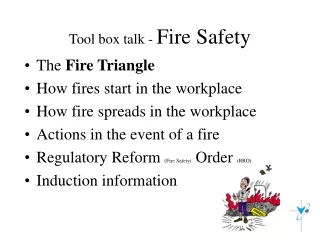
Tool box talk - Fire Safety • The Fire Triangle • How fires start in the workplace • How fire spreads in the workplace • Actions in the event of a fire • Regulatory Reform (Fire Safety) Order (RRO) • Induction information
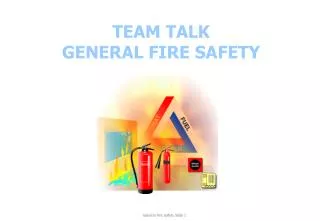
Tool box talk - Fire Safety We require 3 things for fire to occur OXYGEN - FUEL - HEAT
Tool box talk - Fire Safety How fire starts in the workplace • Defective equipment • Poor storage of flammable products • Inappropriate use of heat sources • Arson • Discarded smoking materials
Tool box talk - Fire Safety How fire spreads in the workplace • Delayed discovery • Poor housekeeping • Slow to raise alarm • Propping open fire doors • Goods blocking access routes • Goods blocking fire equipment • Spillage of flammable liquids
Regulatory Reform (Fire Safety) Order (RRO) • Vitafoam have previously been issued with a fire certificate by the Health and Safety Executive as a ‘Special premises ‘ • Under the RRO sites have to carryout in-depth fire risk assessments • The enforcing body is now the Fire Authority.
Regulatory Reform (Fire Safety) Order (RRO) • The Order came into force on October 1st 2006 and has radically change fire safety legislation. • The new legislation revolves around three important aspects i.e. • The ‘Responsible Person’, which is a new position • The fire risk assessment, which is now more in depth • The requirement to manage fire safety matters, derived from the Management of Health and Safety at Work Regulations
Regulatory Reform (Fire Safety) Order (RRO) • The ‘Responsible Person’ • This will be Vitafoam as the employer • Certain people will have duties to ensure compliance • The fire risk assessment, has been carried out and is held in the engineering dept. • Work is ongoing to ensure compliance
Regulatory Reform (Fire Safety) Order (RRO) • Management of fire safety matters • Various works will be phased in over the coming months to ensure that we meet all aspects of the new legislation. • Some will be procedures • Some will be equipment / building changes
Regulatory Reform (Fire Safety) Order (RRO) • What does this mean for me & my department? • Keep my area clean and tidy (House keeping) • Report faulty or missing fire equipment • Don’t miss use fire equipment (door propping etc) • Ensure that you are signed in / out each time you arrive at or leave the premises on your fire register • A safer premises with reduced fire risks
Regulatory Reform (Fire Safety) Order (RRO) • Monthly checks carried out on fire equipment i.e. Fire Doors & Fire extinguishers • Fire Drills which include the stopping up of some exit routes! • Visits from the Fire Authority to check the premises • More trained fire marshals • Better muster locations
Fire safety information - Induction training • Fire safety information must be provided to all workers during induction training; • When first joining the business and when moving to a new role within the business. • This induction must explain:
Fire safety information - Induction training • Actions in the event of fire • How to prevent fire • The fire alarm • What to do if the alarm is activated. • Where the emergency exits are. • How work that could cause fire is managed. • What the main fire risks on the site are. • Location of the Fire Assembly Points
Fire safety information - Induction training Actions in the event of fire • Immediately raise/activate the alarm • Leave the building by safest route • Do not stop to collect belongings • Report to your assembly point • Do not re-enter building (until authorised, even if the alarm has been silenced)
Fire safety information - Induction trainingHow to prevent fire Fire spreads in the workplace because of various reasons • Delayed discovery • Poor housekeeping • Persons are slow to raise alarm Do Not • Prop open fire doors • Block access routes • Blocking fire equipment • Spillage of flammable liquids • Discard smoking materials improperly
Fire safety information - Induction trainingThe fire alarm What the fire alarm sounds like. • The fire alarm is a continuous loud tone, if you think that you cannot hear it clearly report this with a hazard report. How to raise the alarm and call the fire brigade. • Security and external monitoring will call the fire brigade. The operation of the fire alarm. • The fire alarm can operate due to the following • Activation of a manual call point • Activation of the sprinkler system • Activation of a smoke detector
Fire safety information - Induction trainingWhat to do if the alarm is activated. • Leave the building by safest route • Do not stop to collect belongings • Report to your assembly point • Do not re-enter building (until authorised, even if the alarm has been silenced)
Fire safety information - Induction trainingWhere the emergency exits are.
Fire safety information - Induction training How work that could cause fire is managed. • Work that may start a fire could be hot work, i.e. grinding, welding, braising etc. • This type of work is controlled by Risk Assessments, Method Statement and the companies Permit to Work System.
Fire safety information - Induction trainingWhat the main fire risks on the site are. • Arson • Electrical equipment • Smoking. Only smoke in the designated smoking areas and take great care when discarding cigarettes, lighters and matches. • Flammable liquids • Uncontrolled exothermic reaction • Dust build up on machinery
Vitafoam Fire Assembly Points • The fire assembly points have been reviewed and altered to ensure safety and good order during emergencies. • H – Located in main works car park, for Contractors, Delivery Drivers, C.P.T. Middleton Conversion and Engineering. • J - Located in visitors car park, for Vitafoam Offices, Directors, Accounts, Purchasing, Human Resources, Computer Staff, Block Production, Laboratory and Office personnel. • K - Area next to gate to Green Street, for Block Loaders, drivers and Despatch Office personnel. • D – Garage car park, for Garage personnel and visitors.
Tool Box Talk Any Questions ?