Understanding Context-Free Grammars in Language Syntax
510 likes | 622 Views
This session introduces students to context-free grammars and syntax for spoken language modeling, covering key notions such as constituency and ordering in grammar, grammatical relations, and dependency. Students will learn about constituents, rules, terminals, and non-terminals in context-free grammars, with a focus on phrase structure grammars and Backus-Naur form. The session explores how to generate strings in a language, reject strings not in the language, and impose structures on strings using derivations. Additionally, it covers parsing as the process of returning a parse tree for a given string and presents examples of English grammar fragments, sentence types, and noun phrases.


Understanding Context-Free Grammars in Language Syntax
E N D
Presentation Transcript
Session 13 Context-Free Grammars and Language Syntax Introduction to Speech and Natural Language Processing (KOM422) Credits: 3(3-0)
Special Instructional Objectives, Subtopics and Presentation Time Special Instructional Objectives: Students are able to explain the concepts of context-free grammars and syntax for spoken language modelling Subtopics: Review of context-free grammars Syntax and syntax tree Spoken language syntax Presentation Time: 1 x 100 minutes
Syntax • Why should you care? • Grammars (and parsing) are key components in many applications • Grammar checkers • Dialogue management • Question answering • Information extraction • Machine translation
Syntax • Key notions that we’ll cover • Constituency • And ordering • Grammatical relations and Dependency • Heads, agreement • Key formalism • Context-free grammars • Resources • Treebanks
Constituency • The basic idea here is that groups of words within utterances can be shown to act as single units. • And in a given language, these units form coherent classes that can be be shown to behave in similar ways • With respect to their internal structure • And with respect to other units in the language
Constituency • Internal structure • We can describe an internal structure to the class (might have to use disjunctions of somewhat unlike sub-classes to do this). • External behavior • For example, we can say that noun phrases can come before verbs
Constituency • For example, it makes sense to the say that the following are all noun phrases in English... • Why? One piece of evidence is that they can all precede verbs. • This is external evidence
Grammars and Constituency • Of course, there’s nothing easy or obvious about how we come up with right set of constituents and the rules that govern how they combine... • That’s why there are so many different theories of grammar and competing analyses of the same data. • The approach to grammar, and the analyses, adopted here are very generic (and don’t correspond to any modern linguistic theory of grammar).
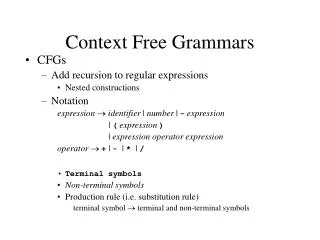
Context-Free Grammars • Context-free grammars (CFGs) • Also known as • Phrase structure grammars • Backus-Naur form • Consist of • Rules • Terminals • Non-terminals
Context-Free Grammars • Terminals • We’ll take these to be words (for now) • Non-Terminals • The constituents in a language • Like noun phrase, verb phrase and sentence • Rules • Rules consist of a single non-terminal on the left and any number of terminals and non-terminals on the right.
Some NP Rules • Here are some rules for our noun phrases • Together, these describe two kinds of NPs. • One that consists of a determiner followed by a nominal • And another that says that proper names are NPs. • The third rule illustrates two things • An explicit disjunction • Two kinds of nominals • A recursive definition • Same non-terminal on the right and left-side of the rule
Generativity • As with FSAs and FSTs, you can view these rules as either analysis or synthesis engines • Generate strings in the language • Reject strings not in the language • Impose structures (trees) on strings in the language
Derivations • A derivation is a sequence of rules applied to a string that accounts for that string • Covers all the elements in the string • Covers only the elements in the string
Definition • More formally, a CFG consists of
Parsing • Parsing is the process of taking a string and a grammar and returning a (multiple?) parse tree(s) for that string • It is completely analogous to running a finite-state transducer with a tape • It’s just more powerful • This means that there are languages we can capture with CFGs that we can’t capture with finite-state methods • More on this when we get to Ch. 13.
An English Grammar Fragment • Sentences • Noun phrases • Agreement • Verb phrases • Subcategorization
Sentence Types • Declaratives: A plane left. S NP VP • Imperatives: Leave! S VP • Yes-No Questions: Did the plane leave? S Aux NP VP • WH Questions: When did the plane leave? S WH-NP Aux NP VP
Noun Phrases • Let’s consider the following rule in more detail... NP Det Nominal • Most of the complexity of English noun phrases is hidden in this rule. • Consider the derivation for the following example • All the morning flights from Denver to Tampa leaving before 10
NP Structure • Clearly this NP is really about flights. That’s the central criticial noun in this NP. Let’s call that the head. • We can dissect this kind of NP into the stuff that can come before the head, and the stuff that can come after it.
Determiners • Noun phrases can start with determiners... • Determiners can be • Simple lexical items: the, this, a, an, etc. • A car • Or simple possessives • John’s car • Or complex recursive versions of that • John’s sister’s husband’s son’s car
Nominals • Contains the head and any pre- and post- modifiers of the head. • Pre- • Quantifiers, cardinals, ordinals... • Three cars • Adjectives and Aps • large cars • Ordering constraints • Three large cars • ?large three cars
Postmodifiers • Three kinds • Prepositional phrases • From Seattle • Non-finite clauses • Arriving before noon • Relative clauses • That serve breakfast • Same general (recursive) rule to handle these • Nominal Nominal PP • Nominal Nominal GerundVP • Nominal Nominal RelClause
Agreement • By agreement, we have in mind constraints that hold among various constituents that take part in a rule or set of rules • For example, in English determiners and their head nouns in NPs have to agree in their number. This flight Those flights *This flights *Those flight
Problem • Our earlier NP rules are clearly deficient since they don’t capture this constraint • NP Det Nominal • Accepts, and assigns correct structures, to grammatical examples (this flight) • But its also happy with incorrect examples (*these flight) • Such a rule is said to overgenerate • Linguists worry about this a lot • We’ll come back to this in a bit
Verb Phrases • English VPs consist of a head verb along with 0 or more following constituents which we’ll call arguments.
Subcategorization • But, even though there are many valid VP rules in English, not all verbs are allowed to participate in all those VP rules. • We can subcategorize the verbs in a language according to the sets of VP rules that they participate in. • This is a modern take on the traditional notion of transitive/intransitive. • Modern grammars may have 100s or such classes.
Subcategorization • Sneeze: John sneezed • Find: Please find [a flight to NY]NP • Give: Give [me]NP[a cheaper fare]NP • Help: Can you help [me]NP[with a flight]PP • Prefer: I prefer [to leave earlier]TO-VP • Told: I was told [United has a flight]S • …
Subcategorization • *John sneezed the book • *I prefer United has a flight • *Give with a flight • As with agreement phenomena, we need a way to formally express the constraints
Why? • Again, the various rules for VPs overgenerate • They permit the presence of strings containing verbs and arguments that don’t go together • For example • VP -> V NP therefore Sneezed the book is a VP since “sneeze” is a verb and “the book” is a valid NP
Possible solution for agreement. Can use the same trick for all the verb/VP classes. SgS -> SgNP SgVP PlS -> PlNp PlVP SgNP -> SgDet SgNom PlNP -> PlDet PlNom PlVP -> PlV NP SgVP ->SgV Np … Possible CFG Solution
CFG Solution for Agreement • It works and stays within the power of CFGs • But it’s truly ugly • And it doesn’t scale all that well because of the interaction among the various constraints explodes the number of rules in our grammar.
The Point • CFGs appear to be just about what we need to account for a lot of basic syntactic structure in English. • But there are problems • That can be dealt with adequately, although not elegantly, by staying within the CFG framework. • There are simpler, more elegant, solutions that take us out of the CFG framework (beyond its formal power) • LFG, HPSG, Construction grammar, XTAG, etc. • Chapter 15 explores the unification approach in more detail • We’re not going there...
Treebanks • Treebanks are corpora in which each sentence has been paired with a parse tree (presumably the right one). • These are generally created • By first parsing the collection with an automatic parser • And then having human annotators correct each parse as necessary. • This generally requires detailed annotation guidelines that provide a POS tagset, a grammar and instructions for how to deal with particular grammatical constructions.
Penn Treebank • Penn TreeBank is a widely used treebank. • Most well known is the Wall Street Journal section of the Penn TreeBank. • 1 M words from the 1987-1989 Wall Street Journal.
Treebank Grammars • Treebanks implicitly define a grammar for the language covered in the treebank. • Simply take the local rules that make up the sub-trees in all the trees in the collection and you have a grammar. • Not complete, but if you have decent size corpus, you’ll have a grammar with decent coverage.
Treebank Grammars • Such grammars tend to be very flat due to the fact that they tend to avoid recursion. • To ease the annotators burden • For example, the Penn Treebank has 4500 different rules for VPs. Among them...
Heads in Trees • Finding heads in treebank trees is a task that arises frequently in many applications. • Particularly important in statistical parsing • We can visualize this task by annotating the nodes of a parse tree with the heads of each corresponding node.
Head Finding • The standard way to do head finding is to use a simple set of tree traversal rules specific to each non-terminal in the grammar.
Treebank Uses • Treebanks (and headfinding) are particularly critical to the development of statistical parsers • Chapter 14 • We will get there • Also valuable to Corpus Linguistics • Investigating the empirical details of various constructions in a given language • How often do people use various constructions and in what contexts... • Do people ever say ...
Dependency Grammars • Turns out that the whole CFG approach does have some shortcomings... • It leads to efficiency/tractability problems during parsing • It doesn’t work very well (or tell us much) with various languages • So-called free word order or scrambling languages • Languages where the morphology does more of the work • And it often turns out that we don’t really need much of what the trees contain
Dependency Grammars • But it turns out you can get a lot done with just binary relations among the words in an utterance. • In a dependency grammar framework, a parse is a tree where • the nodes stand for the words in an utterance • The links between the words represent dependency relations between pairs of words. • Relations may be typed (labeled), or not.
Dependency Parse They hid the letter on the shelf
Dependency Parsing • The dependency approach has a number of advantages over full phrase-structure parsing. • Deals well with free word order languages where the constituent structure is quite fluid • Parsing is much faster than CFG-based parsers • Dependency structure often captures the syntactic relations needed by later applications • CFG-based approaches often extract this same information from trees anyway.
Dependency Parsing • There are two modern approaches to dependency parsing • Optimization-based approaches that search a space of trees for the tree that best matches some criteria • Many use a minimum weighted spanning tree approach • Shift-reduce approaches that greedily take actions based on the current word and state.
Summary • Context-free grammars can be used to model various facts about the syntax of a language. • When paired with parsers, such grammars constitute a critical component in many applications. • Constituency is a key phenomena easily captured with CFG rules. • But agreement and subcategorization do pose significant problems • Treebanks pair sentences in corpus with their corresponding trees.