Importance of Hearing Conservation in the Workplace
This guide covers the laws and benefits of hearing conservation, the anatomy of the ear, types of hearing loss, degree of risk factors, noise exposure levels, personal protective equipment, NRRs, exposure limits, monitoring requirements, audiograms, training, recordkeeping, noise control methods, and steps to reduce noise exposure in the workplace.

Importance of Hearing Conservation in the Workplace
E N D
Presentation Transcript
Hearing Conservation and Noise Control
WHY?????? • It’s the LAW • Quality of Life • Gradual / Painless
Anatomy of the Ear Pinna Semi-Circular Canals Auditory Nerve Cochlea Hammer-Anvil-Stirrup
Types of Hearing Loss • Conductive • Central • Sensorineural
Degree of Risk • Frequency • Intensity • Duration • Individual Variability
How Loud is Loud? • Jet engine 140 db • Threshold of Pain 125 db • Pneumatic hammer 110 db • Compressed Air 105+ db • Punch Press 95 db • Lawn Mower 90 db • Conversation 65 db
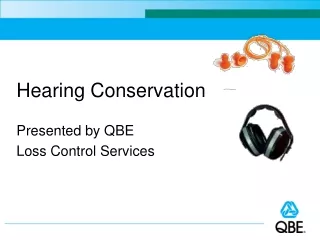
Personal Protective Equipmentadvantages / disadvantages • Cotton Balls • Canal Blockers • Ear Muffs • Ear Plugs • NRRs(example on next page)
NRRs • EPA protocol • For “A” scale measurements NRR – 7 Noise exposure 92 dBA Manufacturer’s NRR 32 32 – 7 = 25 (effective noise exposure reduction) 92 – 25 = 67 dBA
Exposure Limits • ACGIH 85 dBA • NIOSH 85 dBA • OSHA 84 dBA 85 - 89 dBA 90 dBA
Noise Monitoring • Required by the OSHA standard to identify all noise above 80 dBA • Monitoring must be performed whenever there is an increase in production or equipment is added that could increase the noise level
Training requirements • Annual Training • Hearing Conservation Elements • Hearing Protectors
Recordkeeping • Monitoring records • Audiometric testing records
Noise Control • Engineering • Administrative • Personal Protective Equipment
What we’re doing to control noise • Fill in here what you’re company is doing to reduce exposure to noise……..