Download

1 / 25

E N D
Requirement of battery in PV Systems A fundamental characteristic of a photovoltaic system is that power is produced only while sunlight is available. For systems in which the photovoltaics is the sole generation source, storage is typically needed since an exact match between available sunlight and the load is limited to a few types of systems. For example powering a cooling fan. In grid based system, it is not required. In any photovoltaic system that includes batteries, the batteries become a central component of the overall system which significantly affect the cost, maintenance requirements, reliability, and design of the photovoltaic system. Because of large impact of batteries in a stand-alone photovoltaic system, understanding the properties of batteries is critical in understanding the operation of photovoltaic systems. The important battery parameters that affect the photovoltaic system operation and performance are the battery maintenance requirements, lifetime of the battery, available power and efficiency.
A battery converts the chemical energy into electrical energy by Redox reaction. Redox reaction: oxidation and reduction reactions. Redox reactions are chemical reactions in which an electron is either required or produced by the chemical reaction. There are two types of batteries: Primary and secondary For primary batteries, this is a one-way process – the chemical energy is converted to electrical energy, but the process is not reversible and electrical energy cannot be converted to chemical energy. This means that a primary battery cannot be recharged. e.g. alkaline consumer batteries used in flashlights, etc. In a secondary battery, the conversion process between electrical and chemical energy is reversible; chemical energy is converted to electrical energy, and electrical energy can be converted to chemical energy, allowing the battery to be recharged. For photovoltaic systems, all batteries used must be rechargeable or secondary batteries. Common examples of secondary batteries are lead acid batteries and lithium-ion batteries used in higher power consumer electronic equipment such as computer laptops, camcorders, mobile phones, and some digital cameras.
Redox reaction: Oxidation reaction: Increase in the charge state If a material gives up or loses an electron, then its valance state becomes more positive and the reaction is called an oxidation reaction. Reduction reaction: If a material gains an electron then its valance state decreases or reduces due to the negative charge of the electrons and the reaction is a reduction reaction.
The total redox reaction consists of both of the two reactions together. For the example of copper and zinc above, the total reaction is shown below. Since the reaction with zinc metal (i.e. the reactant of the oxidation reaction) is providing the electron required to reduce the copper, the zinc is the reducing agent and the zinc itself is oxidized. Copper ions in this case are the oxidizing agent - they oxidize the zinc and are themselves reduced. Since the electrons appear on both sides of the chemical equation, they may be omitted when writing the redox reaction. Further note that for redox reaction, it is important to balance not only the elements in the chemical reactions, but also the electrons.
Electrochemical Potential The voltage or potential difference between an oxidation and reduction reaction arises from the different electrochemical potentials of the reduction and oxidation reactions in the battery. The electrochemical potential is a measure of the difference between the average energy of the outer most electrons of the molecule or element in its valence states. Anode: Oxidation Cathode: Reduction
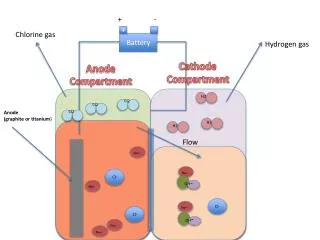
The basis for a battery operation is the exchange of electrons between two chemical reactions, an oxidation reaction and a reduction reaction. Oxidationand Reductionreaction are physically separated The electrochemical potential difference corresponds to the voltageof the battery and the exchange of electrons between the two reactions corresponds to the current that passes through the load.
The materials used for the electrode and electrolyte for both the oxidation and reduction reactions are the key components which determines many of the basic properties of the battery. Electrode are the physical locations. In many battery systems, including lead acid and alkaline batteries, the electrode is not only where the electron transfer takes places, but is also a component in the chemical reaction that either uses or produces the electron. For a discharging battery, the electrode at which the oxidation reaction occurs is called the anode and by definition has a positive voltage, and the electrode at which the reduction reaction occurs is the cathode and is at a negative voltage. The other chemical components of the reaction are contained in the electrolyte. For many practical battery systems, the electrolyte is an aqueous solution. The current in the battery arises from the transfer of electrons from one electrode to the other. During discharging, electrons flow from the anode to the cathode.
Electrical neutrality is maintained by the movement of ions in the electrolyte. If each redox reaction has a different electrolyte, a salt bridge joins the two electrolyte solutions. The direction of the ion movement acts to prevent a charge build-up at either the anode or the cathode. In most practical battery systems, the same electrolyte is used for both the anode and the cathode, and ion transport can take place via the electrolyte itself, eliminating the need for a salt bridge. However, in this case a separator is also inserted between the anode and the cathode. The separator prevents the anode and cathode from physically touching each other.
The battery capacity is a measure of the amount of charge or energy stored in the battery. The fundamental units of battery capacity is coulombs (C), although a more common and useful unit is Amp-hrs (Ah). For photovoltaic systems, the key technical considerations are that the battery experience a long lifetime under nearly full discharge conditions. Battery Charging and Discharging The key function of a battery in a PV system is to provide power when other generating sourced are unavailable, and hence batteries in PV systems will experience continual charging and discharging cycles. All battery parameters are affected by battery charging and recharging cycle. Battery State of Charge (BSOC): The BSOC is defined as the fraction of the total energy or battery capacity that has been used over the total available from the battery. For example, for a battery at 80% SOC and with a 500 Ah capacity, the energy stored in the battery is 400 Ah. A common way to measure the BSOC is to measure the voltage of the battery and compare this to the voltage of a fully charged battery.
Depth of Discharge The Depth of Discharge (DOD) of a battery determines the fraction of power that can be withdrawn from the battery. For example, if the DOD of a battery is given by the manufacturer as 25%, then only 25% of the battery capacity can be used by the load. For example, a battery 500 Ah with a DOD of 20% can only provide 500Ah x .2 = 100 Ah. Daily Depth of Discharge The daily depth of discharge determined the maximum amount of energy that can be extracted from the battery in a 24 hour period. Typically in a larger scale PV system (such as that for a remote house), the battery bank is inherently sized such that the daily depth of discharge is not an additional constraint. However, in smaller systems that have a relatively few days storage, the daily depth of discharge may need to be calculated. Charging and Discharging Rates A common way of specifying battery capacity is to provide the battery capacity as a function of the time in which it takes to fully discharge the battery (note that in practice the battery often cannot be fully discharged). The notation to specify battery capacity in this way is written as Cx, where x is the time in hours that it takes to discharge the battery.
The charging rate, in Amps, is given in the amount of charge added the battery per unit time (i.e., Coulombs/sec, which is the unit of Amps). The charging/discharge rate may be specified directly by giving the current. Charging and Discharging Regimes Each battery type has a particular set of restraints and conditions related to its charging and discharging regime, and many types of batteries require specific charging regimes or charge controllers. The voltage and current during the charge cycle will be different for each type of battery. Typically, a battery charger or charge controller designed for one type of battery cannot be used with another type.
What Types of Batteries are Used in Solar Electric Systems? There are four main types of battery used in connection with storing electricity from solar power systems. LEAD ACID LITHIUM NICAD (NICKEL CADMIUM) Sodium Nickel Chloride Absorbed Glass Mat
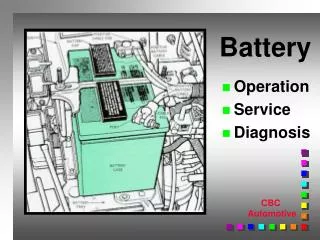
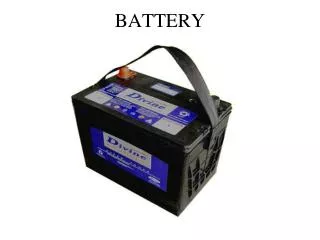
Battery Construction Lead acid batteries used in many Industries like Marine, automobile etc. Consist of two 6-volt batteries in series, or a single 12-volt battery. These batteries are constructed of several single cells connected in series. A battery cell consists of two lead plates a positive plate covered with a paste of lead dioxide and a negative made of sponge lead, with an insulating material (separator) in between. The plates are enclosed in a plastic battery case and then submersed in an electrolyte consisting of water and sulfuric acid. Storage battery https://www.progressivedyn.com/service/battery-basics/
The size of the battery plates and amount of electrolyte determines the amount of charge that a lead acid batteries can store. A typical 12-volt battery has a rating 125 AH, which means it can supply 10 amps of current for 12.5 hours or 20-amps of current for a period of 6.25 hours. Lead acid batteries can be connected in parallel to increase the total AH capacity.
Lead Acid Battery Discharge Cycle A fully charged battery is connected to a load (light bulb) and the chemical reaction between sulfuric acid and the lead plates produces the electricity to light the bulb. This chemical reaction also begins to coat both positive and negative plates with a substance called lead sulfate also known as sulfation (shown as a yellow build-up on plates). This build-up of lead sulfate is normal during a discharge cycle. As the battery continues to discharge, lead sulfate coats more and more of the plates and battery voltage begins to decrease from fully charged state of 12.6-volts
Lead Acid Battery Recharge Cycle The most important thing to understand about recharging lead acid batteries is that a converter/charger with a single fixed output voltage will not properly recharge or maintain your battery. Proper recharging and maintenance requires an intelligent charging system that can vary the charging voltage based on the state of charge and use of your RV or Marine battery. Progressive Dynamics has developed intelligent charging systems that solve battery problems and reduce battery maintenance. In order to recharge a 12-volt lead acid battery with a fully charged terminal voltage of 12.6-volts, the charger voltage must be set at a higher voltage. Most converter/chargers on the market are set at approximately 13.6-volts. During the battery recharge cycle lead sulfate (sulfation) begins to reconvert to lead and sulfuric acid.
During the recharging process as electricity flows through the water portion of the electrolyte and water, (H2O) is converted into its original elements, hydrogen and oxygen. These gasses are very flammable and the reason your RV or Marine batteries must be vented outside. Gassing causes water loss and therefore lead acid batteries need to have water added periodically. Sealed lead acid batteries contain most of these gasses allowing them to recombine into the electrolyte. If the battery is overcharged pressure from these gasses will cause relief caps to open and vent, resulting in some water loss. Most sealed batteries have extra electrolyte added during the manufacturing process to compensate for some water loss.
Fully recharged battery using a fixed charging voltage of 13.6-volts. Notice that some lead sulfate (sulfation) still remains on the plates. This build-up will continue after each recharging cycle and gradually the battery will begin to loose capacity to store a full charge and eventually must be replaced. Lead sulfate build up is reduced if battery is given an Equalizing Charge once every 10 discharge cycles or at least once a month. An Equalizing Charge increases charging voltage to 14.4 volts or higher for a short period. This higher voltage causes gassing that equalizes (re-mixes) the electrolyte solution. Progressive Dynamics has developed the microprocessor controlled Charge Wizard. The Charge Wizard will automatically provide an Equalizing Charge every 21 hours for a period of 15 minutes, when the battery is fully charged and not in use. Our 2000 Series of Marine Battery Chargers have the Charge Wizard feature built-in.
Battery Lifetime and Maintenance The lifetime of battery for PV applications is defined by the number of charge/discharge cycles over which the battery maintains a given fraction of its capacity. Batteries involve chemical reactions that are reactive, the materials used in batteries are susceptible to alternate reactions that degrade battery performance. The battery lifetime is typically controlled by the gradual degradation in battery capacity which accompanies charge/discharge cycles. Consequently, battery lifetime is typically given as the number of charge/discharge cycles which it can undergo and still maintain its original capacity. Some types of battery reactions evolve gasses and other products which change the volume of the components in the battery. battery will need to have certain chemical components (usually simply water) added to compensate for the evolution of gasses. A hermetically sealed battery does not exchange any materials with its surrounding environment. Lead acid batteries, require a strict maintenance schedule.
Failure Modes Modes are: shorts, degradation of electrode material, freezing, increases in resistance. Battery Voltage The voltage of a battery is a fundamental characteristic of a battery, which is determined by the chemical reactions in the battery, the concentrations of the battery components, and the polarization of the battery. Voltage Variation with Discharging
Cut-Off Voltage The voltage below which the battery should not discharge to avoid permanent damage is called cut off Voltage. Uses of batteries in PV systems The primary function of a storage system is to provide power when sunlight is not available, hence increasing the fraction of time the photovoltaic system provides electricity. The addition of batteries has numerous other advantages which mean that the batteries can be used for multiple purposes. For small systems consisting of one or two photovoltaic modules, batteries can act as a load-matching system. In photovoltaic systems which contain a load with a large initial current draw (such as experienced by an inductive load, typically represented by a motor), the batteries can be used to provide initial start-up current. In grid-connected systems, battery storage can be used for peak shifting, in which the power generated by the sun is stored for several hours in order to better match when the peak load occurs.
The most basic safety device in a battery is a fuse that opens on high current. The resistance of the PTC is low during normal operation and increases when the temperature rises above a critical level to reduce current flow. The PTC is reversible and returns to high conductivity when the temperature normalizes. The current interrupt device (CID) is a fuse-type device that cuts off the electrical circuit permanently when triggered by excessive cell pressure, high temperature, or high voltage, depending on design.