Understanding Vector Components: Coordinates, Addition, and Subtraction
This guide explores vector components and their representation in coordinate systems. Learn how to describe vectors in terms of coordinates, such as 6.0 km east and 3.4 km south. Understand the importance of ordered sets of components, where each scalar is associated with a coordinate. Discover methods for vector addition, subtraction, and scalar multiplication, including how to find components using trigonometry. We also cover applications such as calculating magnitudes and angles of vectors from their components to enhance your understanding of vector mathematics.

Understanding Vector Components: Coordinates, Addition, and Subtraction
E N D
Presentation Transcript
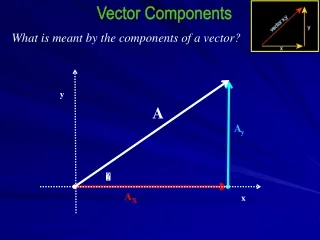
y x Coordinates • Vectors can be described in terms of coordinates. • 6.0 km east and 3.4 km south • 1 m forward, 2 m left, 2 m up • Coordinates are associated with axes in a graph. x = 6.0 m y = -3.4 m
Ordered Set • The value of the vector in each coordinate can be grouped as a set. • Each element of the set corresponds to one coordinate. • The elements, called components, are scalars, not vectors.
Component Addition • A vector equation is actually a set of equations. • One equation for each component • Components can be added and subtracted like the vectors themselves
Scalar Multiplication • A vector can be multiplied by a scalar. • For instance, walk twice as far as in the hiking example. • Scalar multiplication multiplies each component by the same factor. • The result is a new vector, always parallel to the original vector.
Component Subtraction • Multiplying a vector by -1 will create an antiparallel vector of the same magnitude. • Vector subtraction is equivalent to scalar multiplication and addition.
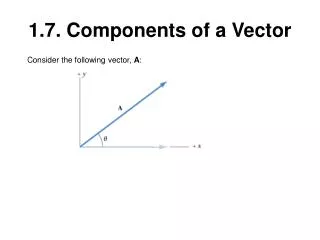
Find the components of vector of magnitude 2.0 km at 60° up from the x-axis. Use trigonometry to convert vectors into components. x = r cos y = r sin y x Use of Angles y = (2.0 km) sin(60°) = 1.7 km 60° x = (2.0 km) cos(60°) = 1.0 km
Find the magnitude and angle of a vector with components x = -5.0 m, y = 3.3 m. y x Components to Angles x = -5.0 m L y = 3.3 m L = 6.0 m = 33o above the negative x-axis next