Advanced Microbiological Techniques
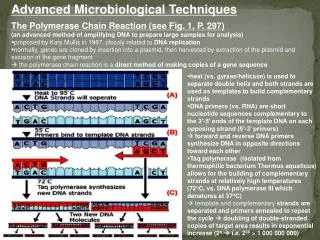
Advanced Microbiological Techniques. The Polymerase Chain Reaction (see Fig. 1, P. 297) (an advanced method of amplifying DNA to prepare large samples for analysis) proposed by Kary Mullis in 1987, closely related to DNA replication

Advanced Microbiological Techniques
E N D
Presentation Transcript
Advanced Microbiological Techniques • The Polymerase Chain Reaction (see Fig. 1, P. 297) • (an advanced method of amplifying DNA to prepare large samples for analysis) • proposed by Kary Mullis in 1987, closely related to DNA replication • normally, genes are cloned by insertion into a plasmid, then harvested by extraction of the plasmid and excision of the gene fragment • the polymerase chain reaction is a direct method of making copies of a gene sequence • heat (vs. gyrase/helicase) is used to separate double helix and both strands are used as templates to build complementary strands • DNA primers (vs. RNA) are short nucleotide sequences complementary to the 3’-5’ ends of the template DNA on each opposing strand (5’-3’ primers) • forward and reverse DNA primers synthesize DNA in opposite directions toward each other • Taq polymerase (isolated from thermophilic bacterium Thermus aquaticus) allows for the building of complementary strands at relatively high temperatures (72oC, vs. DNA polymerase III which denatures at 37oC) • template and complementary strands are separated and primers annealed to repeat the cycle doubling of double-stranded copies of target area results in exponential increase (2n i.e. 230 > 1 000 000 000)
target area is not completely isolated in the first few cycles of DNA replication • First Cycle: two variable-length strands are produced that start at the target region where the primer has annealed on one end, and extend beyond the target region on the other end • Second Cycle: on two of the strands, one end terminates at the target region (from the variable-length strands produced in the first cycle), and the primers anneal to the other end of the target area • nucleotides are added, commencing from the primer and ceasing when the end that terminates at the target region is reached, resulting in constant-length strands • other two strands are extended by Taq polymerase as in the first cycle • .third cycle: target strand copies increase exponentially • Use of PCR • forensic criminal investigations (small amount of DNA needed as starting point for copying) • medical diagnosis (i.e. instead of waiting for presence of HIV antibodies, primers are designed that are complementary to HIV DNA, then amplified to look for HIV genome) • genetic research (species relatedness from fossil evidence) Practise – P. 298, #1,2
Restriction Fragment Length Polymorphism (an advanced method to sort and analyze DNA molecules) • individuals of the same species have different alleles for the same genes, so their genome is polymorphic • polymorphisms in coding regions can identify individuals with mutations • in noncoding regions, variations exist in the number of variable number tandem repeats (VNTR’s)or microsatellites (repeating base pair sequences varying in length and position) which can be exploited in forensic investigations • gel electrophoresis is unable to resolve individual fragments because they are too numerous and differ only slightly in size over a wide range • RFLP analysis compares lengths of DNA fragments produced by restriction enzyme digestion and revealed by complementary radioactive probes to determine genetic differences between individuals • (refer to Figure 3, P. 299)
double-stranded DNA is denatured to become single-stranded, then transferred and bound to a nylon membrane (negatively charged DNA is “blotted” onto membrane by placing a positive electrode behind the gel = Southern blot) single-stranded DNA is immersed in a solution containing radioactive complementary nucleotide probes for specifically chosen regions (regions may be mutations in an allele or a variable number tendem repeat in a noncoding region) • hybridization produces complementary base pairing between the probes and the DNA the nylon membrane is placed against X-ray film, where radioactive probes cause exposure in the areas of hybridization and produces an autoradiogram the pattern revealed in the exposed film can be used to match a suspect’s DNA to the DNA found at a crime scene Practise – P. 300, #6-14
DNA Sequencing (refer to Fig 4, P. 301) • the Sanger dideoxy (chain termination) method is the the most popular and easily automated DNA sequencing protocol • dideoxy analogs of deoxynucleoside triphosphates (dNTPs) are missing the OH-group from the deoxyribose sugar DNA polymerase is unable to catalyze the phosphodiester linkage between the growing chain and the incoming nucleotide • A radioactive DNA primer is annealed to a single-stranded DNA template • Identical copies of the primed template are placed in four separate reaction tubes, each containing DNA polymerase, deoxynucleoside triphosphates (dATP, dTTP, dGTP, dCTP) plus a radioactively labelled dideoxy analogue (ddNTP) of one of the dNTPs • since only a fraction of the dNTPs are dideoxy analogues, different lengths of complementary DNA will be built before the analogue is incorporated and the chain stopped • Contents of all four reaction tubes are loaded into separate lanes of a gel and the strands separated by electrophoresis • DNA sequence can be read directly from the gel in ascending order (see Figure 6, P. 302)