
Enhancing Visuomotor Skills Through Quiet Eye Training for Performance Under Pressure
This study explores the significance of the "Quiet Eye" (QE) phenomenon in improving visuomotor skills across various sports and applications like laparoscopic surgery. The QE refers to the duration of the final fixation prior to movement, which is critical for expert performance. Longer QE times are linked to success in high-pressure situations, while shorter QE is often seen in anxious individuals. We investigate training methods to adopt expert-like QE, comparing novice and elite performers to enhance attention and visuo-motor control under anxiety.

Enhancing Visuomotor Skills Through Quiet Eye Training for Performance Under Pressure
E N D
Presentation Transcript
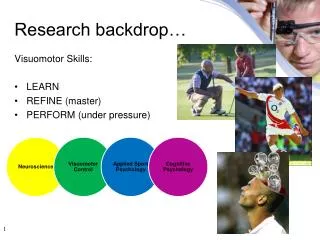
Research backdrop… Visuomotor Skills: • LEARN • REFINE (master) • PERFORM (under pressure)
Visual control- The Quiet Eye • Experts seem to know where and when to look... • The duration of the final fixation prior to movement is critical...! • Named the Quiet Eye • (QE; Vickers, 1996) • Longer QE for experts and successful shots. • Shorter QE when anxious.
Can we train the QE? • (rather than the movement) • LEARN • REFINE • PERFORM
Train to adopt expert QE: • Different sports. • Novice and elite. • QE trained vs. Control. • Training phase. • Testing phase: • Retention (learning) • Pressure (anxiety)
VINE, S.J. & Wilson, M.R. (2011). The influence of quiet eye training and pressure on attention and visuo-motor control. ActaPsychologica: 136, 340–346.
Applications to Surgery... • Laparoscopic surgery: • - ‘Key hole’ surgery • ...is challenging: • - Elongated tools • - 2D Image on screen • ...and stressful: • - Under pressure • - Multi - tasking
Keep your eyeson the prize... Thank you!
