Analysis of Genetic Variants in Chromosome 22 from Illumina Sequencing Data
This assignment involves the analysis of approximately one million Illumina reads mapped to Chromosome 22. The sequence data was processed using Novoalign for mapping and Picard for removing duplicate reads. Variants were called using GATK. The assignment tasks include downloading a VCF file, submitting it to WEB-ANNOVAR, and performing analyses to identify rare nonsynonymous variants, novel variants, functional predictions, and frameshift insertions/deletions. Students will interpret results, focusing on potential disease associations and quality assessments.

Analysis of Genetic Variants in Chromosome 22 from Illumina Sequencing Data
E N D
Presentation Transcript
NGS Assignment part 2
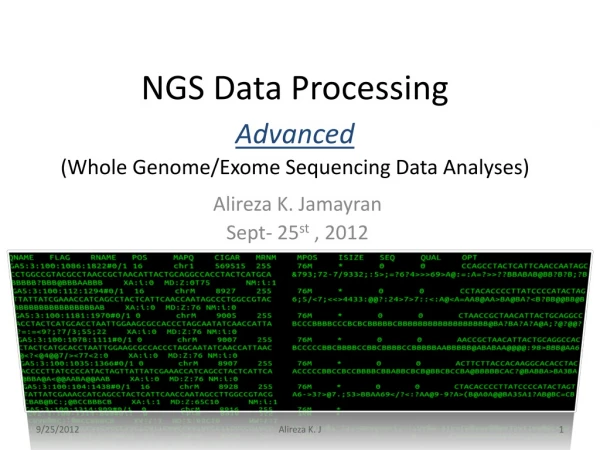
Background • Approximately a million Illumina reads from a single individual • All are from Chromosome 22 • Data was mapped to reference using Novoalign • Duplicate reads were removed using Picard • Variants were called by GATK This is exactly what the shell script intended to do… NOTE: Write up due
The task • Download the variants (VCF file) from the course page • Submit to WEB-ANNOVAR using the standard settings: http://wannovar.usc.edu/ • Download as CSV or separated file and answer the following questions based on filtering with EXCEL, a script, or UNIX command flows…
Answer the following: • Are there any strange ‘variants’. HINT: (remember this is for chromosome 22 only) • How many rare nonsynonymous variants (frequency < 0.05) can you find, based on: • dbSNP • ESP6500 (BONUS: write a bit about WHAT this is) • both • Find a novel variant in the list (c) above • (HINT: if it’s not in dbSNP, it is probably novel) • Do any of the functional prediction tools (LJB_***_Pred) call it ‘deleterious’ (D) or as being at a conserved site (C). • What is the gene? Find as much evidence as you can about possible roles in disease.
How many frameshift insertions/deletions can you find? How many would you trust (HINT: find mentions of quality issues) • How many splicing variants? How many are rare? • BONUS: How many novel, nonsynomous, homozygous variants are there that are predicted as being functional by at least one of the tools (same as in 3b)?