Download
1 / 28
280 likes | 397 Views
Radioactive decay is a fascinating process where unstable parent materials transform into stable daughter products over time. This transformation occurs at a constant rate defined by the half-life, the time it takes for half of a substance to decay. Although we cannot predict which atoms will decay at any given moment or how many will remain, the proportion of parent to daughter isotopes allows us to determine how many half-lives have elapsed. With each half-life, the amounts of parent material decrease while the daughter product increases, revealing the dynamic nature of atomic decay.

E N D
Radioactive materials decay from the “Parent” material into the “Daughter Product”. Daughter Product Original “Parent” Material
You’ll never know which atoms will decay... (16 atoms)
...is that it always takes the same amount of time for half to disappear. (8 atoms)
Don’t worry about the last atom. You start with so many trillions that you never really get there. (It will just decay and then they’re all gone.)
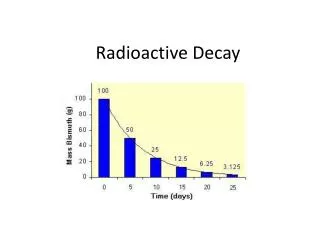
Since you don’t know how many atoms you started with, a ratio between parent to daughter will tell you how many half-lives have gone by. 100% parent 0% daughter 0 half lives
One half-life. 50% parent 50% daughter 1 half-life
Two half-lives. 25% parent 75% daughter 2 half-lives
Three half-lives. 12.5% parent 87.5% daughter 3 half-lives
Four half-lives. 6.25% parent 93.75% daughter 4 half-lives