Exploring the Digital Storytelling of "5 Haitis": Narratives of Resilience and Reality
230 likes | 349 Views
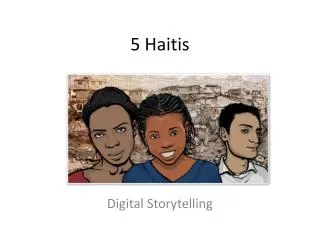
"5 Haitis" is an innovative digital storytelling project that immerses users in the aftermath of the 2010 earthquake. It introduces four unique characters—Omar, Bronte, and Guerda—whose interconnected stories unfold simultaneously, allowing users to explore various narratives and their emotional depths. By breaking the fourth wall, the project encourages deep interaction and engagement, offering a serious reflection on the resilience of Haitian people. The narrative's structure offers a blend of hyper and deep attention, challenging users to connect with the subject matter meaningfully.


Exploring the Digital Storytelling of "5 Haitis": Narratives of Resilience and Reality
E N D
Presentation Transcript
5 Haitis Digital Storytelling
What is 5 Haitis? • Digital narrative • Themes • 2010 Earthquake • Characters • Omar • Bronte • Guerda • Interaction • Character stories • Scene stories • Character dialogues
Intro • The concept • Hyper/deep attention • Serious games • The 4th wall • Other inspirations • The process • Character and narrative development • Graphics and Interactivity • The critique
The Concept • A sombre, serious subject • An event of current concern • Something that would provoke thought, personalise the event
Hyper / Deep Attention • Katherine Hayles – “Hyper attention is characterized by switching focus rapidly among different tasks, preferring multiple information streams, seeking a high level of stimulation, and having a low tolerance for boredom” (Jan, 2008) • How do we prefer to interact? • Deep concentration on one task • Frequently shifting focus around multiple tasks • Which is best? • Situation determines suitability
What about video games? • A seeming paradox • The key • Interactivity and rewards • 1000 gamers involved in a study with University of Rochester • I wanted the narrative to… • Give users freedom to explore and interact • Provide rewards • Provide multiple stimuli simultaneously allowing choice • Lots happening to keep users engaged
An example of hyper/deep attention media • Emphasis on sound and text • Limited interactivity • Text flashes up, animates in time with music • Stimulates hyper and deep attention • WARNING – contains flashing images • An inspiration for the text animation and speed
Serious Games • Games for more than just entertainment • When used in training context can be termed ‘game-learning’ • Can be used to engage users while at the same time delivering a serious message • Examples – Darfur is Dying, Food Force, Floodsim
Users play refugees trying to survive • Tasks include foraging for water, helping their family, irrigation etc • The experience is deepened by the interaction • The subject matter is handled sensitively and seriously
A serious narrative • I wanted the narrative to be serious, allowing interaction in order to make a deeper impression • 5 Haitis is not a game • No protagonist • No main goals • However it does allow autonomy, interaction • Users choose how to explore the narrative • Rewards are given in the form of details learnt • The narrative does progress
The 4th Wall • Represents the imaginary wall separating the audience and the story • Can be broken for dramatic or comedic effect • Used to involve the audience • Tamara (1981) dissolves the 4th wall • Takes place in a large house with ten actors performing simultaneous scenes in the rooms • Audience can choose how to experience the play
5 Haitis and the 4th wall • The barrier between narrative and audience is removed by allowing interaction • Users must choose how to experience the narrative • Characters relate their stories directly to the user apart from the conversations • Everything happens simultaneously allowing repeated viewings
Other Inspirations • ‘Waltz with Bashir’ • Documenting the 1982 Lebanon war • Stark, sombre, dark graphic novel style • Evocative soundtrack
Developing the Idea • Initial idea • Four characters in quadrants • Story set a year on from the earthquake • An aftershock occurs • The user controls the choices of the characters • Problems • Time limitations • Not based on reality • Too complex to programme
Three characters chosen • Relate their histories • Interact with the scene • Interact with the other characters • Narratives occur simultaneously, allowing the user to choose how to experience them • Scene • Typical but fictitious Haitian location • Based on Port-au-Prince • Time Frame • Just before and then one year on from the earthquake
Making Digital Storytelling Work • Break the 4th Wall • Use tension, uncertainty • Employ a character arc • Give characters realistic flaws • Employ role reversals
Creating realistic characters • Character biographies and back histories • Character motivations should be reasonable, understandable • In digital fiction, no room for subtlety • Avoid stereotypes or twist them • Use easy to understand language • Realistic speech and conversation • Clear words and short, bite-sized pieces
Realistic dialogue • In early versions, the dialogue was too unnatural, formal • Suggestions (James, 2009) • Avoid ‘on the nose’ dialogue • Reveal nuances of character personality • Fit the words to suit the character • Characters generally interrupt each other • Use a subtext • Employ humour • Ensure the dialogue adds to/ moves the story forward
The narrative structure • 3 act structure • Act 1 sets the scene and context • Pre-quake scene • Act 2 develops the story, explores conflict, relationships and themes • Pre-quake ending in earthquake • Act 3 is the consequence of acts 1 and 2 • Post-quake • Exploratorium model with fractals • Users can explore bowls of freedom that are connected together • The story expands allowing players to explore freely but following only one theme
Graphical Development • The scene – a composite of multiple photos blended together
Interaction • Built using flash • Interaction achieved through action script • Narrative built using the iterator pattern • This allowed interruptions in back histories to occur and then resume from same position • All narrative in xml form • Allowed definition of timings, pauses, unique id’s for narrative parts
Critique • Main issues in development • Believable characters • Unnatural speech • Consistency • Interactivity • More features were desired • Character, scene animations • More hot spots • Structure • Exploration and multiple viewings
Thanks! • Any questions?