FAFSA
FAFSA. Planning For College Wisely. What is FAFSA?. 1. This is aid from the federal government to help pay for college. 2. It is intended to make up the difference between what your family can afford to pay and the cost of college.


FAFSA
E N D
Presentation Transcript
FAFSA Planning For College Wisely
What is FAFSA? • 1. This is aid from the federal government to help pay for college. • 2. It is intended to make up the difference between what your family can afford to pay and the cost of college. • 3. All families are expected to contribute something to the cost of school. This is the Expected Family Contribution-EFC • 4. More than ½ of the students in college currently receive some sort of aid.
Types of Aid • 1. Loans • 2. Grants • 3. Scholarships • 4. Work Study
What are Loans? • ~ Loans are borrowed money from the government that must be repaid after the student has graduated from college. • ~ This type of loan has a much lower interest rate than what you would borrow from a bank or private loan lender. • ~ There are 2 types of loans. Most common for undergraduates is a Federal Perkins Loan and a Federal Direct Loan.
Specific Loans • ~ Direct Subsidized Loan: 3.86 % fixed rate is the best choice for students. During college the interest is paid by gov’t. You’ll pay after you graduate. This is a need based loan. • ~ Direct Unsubsidized Loan: 3.86% rate but this loan will gain interest while in college. • ~ There is a 1.051% fee on all direct loans • ~ Federal Perkins Loans: 5% rate are for students with great financial need with a 9 mo. grace period. Not all colleges participate in this type of aid.
What are Grants? • ~ This a a gift of money that a student does not have to pay back to the government. It is given to students with great financial need. • ~ 3 Types: Federal, State, & College • ~ Federal Pell Grant: up to 12 semesters • ~ WI Higher Education Grant/WI Tuition Grant • www.heab.state.wi.us • ~ Individual colleges have access to award grant money to help tuition costs
Scholarships • 1. State sponsored scholarships such as: the All State Scholar award • 2. Colleges award scholarships based on academic, athletic, or other talent criteria. • 3. Community scholarships such as the Elks, Kiwanis, and PTA organizations. • 4. Some private affiliations such as: members of clubs, employers, or union organizations.
Work Study? • ~ This is an opportunity to gain employment on your college campus. • ~ The federal government provides the money to the campus for student employment. • ~ This is an opportunity to pay for regular occurring expenses during the school year. • ~ It is a great way to get connected to campus resources right away.
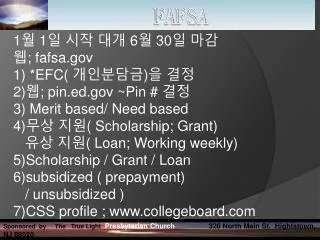
When & how do you apply? • ~ High school students fill out the application in January of their senior year. • ~ This is an electronic application and can be accessed any time after January 1st. http://www.fafsa.gov • ~ This is based on the idea all students should have access to higher education regardless of how much money you have.
What are the costs? • 1. Tuition and Fees, which includes: • Housing • Meal Plan • Transportation • Books & Supplies • Miscellaneous Living Expenses • This all encompasses Cost of Attendance (COA)
Budgeting • 1. Be mindful of the costs and your ability to pay back your loans after you graduate. • 2. All colleges have a Net Price Calculator to help estimate your cost of attendance. This helps to create your budget. • 3. Use a financial aid planner tool to help with this. Allows you to see the whole process of borrowing and how you are responsible for it.
Tools to use for budgeting • 3 options to estimate federal aid for cost of attendance • 1. The Net Price Calculator: this is an option on all college/university web sites • 2. FAFSA4caster • 3. http://studentaid.ed.gov • Tips for college preparations and career search • The Budget Calculator • Student loan management & repayment tools
Borrowing Tips • ~ Think of the entire cost of school in terms of monthly payments. • ~ Borrow only what is needed for direct educational expenses. • ~ Consider the salary you would take home and who much you could afford to pay back monthly. • ~ Always check with your school’s financial aid department before pursuing private loans.